The LP’s Guide to Investing in Boutique Hotels for Asymmetric Upside

Updated: Jun 24

Boutique hotels sit in an interesting corner of real estate investing.
They are real estate, but they do not behave like a passive leased asset. They are hospitality businesses, but the value is still anchored by land, location, design, replacement cost, and physical scarcity.
They can be more operationally demanding than multifamily, retail, or industrial. But when executed well, they can also offer something many traditional real estate assets struggle to provide:
The ability to reprice revenue in real time.
That matters.
In an inflationary environment, long-term leases can become a quiet liability. A commercial building leased for ten years with fixed annual bumps may look stable on paper, but if expenses rise faster than rent, the landlord’s real income can compress. A hotel, by contrast, has the ability to adjust pricing every day based on demand, seasonality, events, compression nights, group business, and market conditions.
That does not make hotels automatically better. It makes them different.
And for LP investors who understand the tradeoff, investing in boutique hotels can offer a compelling mix of inflation responsiveness, operational upside, brand-driven value creation, and asymmetric return potential.
The key is knowing what to look for.
Table of Contents
Why Boutique Hotels Are Getting More Attention From Investors
For years, many real estate investors treated hotels as too cyclical, too operational, or too risky. That reputation was not completely unfair.
Hotels do not have the same contractual rent roll as multifamily, industrial, or office. Revenue can move daily. Expenses require constant management. Labor, reviews, distribution, maintenance, and guest experience all matter.
But that same complexity is also where the opportunity lives. In traditional commercial real estate, value creation is often constrained by lease terms. If a tenant has seven years remaining on a below-market lease, the owner may have limited ability to change income quickly. In hotels, the revenue strategy can change immediately.
That flexibility is becoming more valuable.
CBRE has noted that elevated inflation continues to pressure hotel profits and margins, which means operators need to be more disciplined about pricing, labor, and efficiency. (CBRE Research, 2023)
JLL has also pointed to a bifurcated recovery in hospitality, with luxury hotel RevPAR outperforming weaker midscale and economy segments in 2025.
That is important for boutique hotel investors because the strongest boutique properties are not trying to compete as commodities. They are not trying to be the cheapest bed in the market. They are competing on experience, design, location, story, and service.
In other words, they have more ways to justify pricing power.
That does not mean every boutique hotel is a good investment. Many are not. A property can be beautiful and still be a poor deal. A market can be trendy and still be overbuilt. A sponsor can have a great deck and still lack the operational discipline needed to execute.
But when the right asset, basis, market, and operator come together, boutique hotels can offer a return profile that is difficult to replicate in long-term leased real estate.
What Makes a Boutique Hotel Different?
A boutique hotel is typically a smaller, design-forward hotel with a distinct identity, local character, and experience-driven positioning.
It is not just a hotel with fewer rooms.
The difference is strategic.
A standard select-service hotel often competes on brand flag, loyalty points, location, and consistency. A boutique hotel competes on emotional pull. It gives guests a reason to choose that property specifically, not just a room in that zip code.
Boutique hotels are usually smaller
Many boutique hotels have fewer rooms than institutional full-service hotels. That smaller scale can create operational challenges, but it can also create scarcity.
A 40-room or 80-room hotel in a high-barrier market may not need to capture massive demand. It only needs to win a specific guest segment at the right rate.
That can be powerful.
Boutique hotels are design-forward
Design is not just decoration. In hospitality, design is part of the revenue strategy.
The lobby, rooms, restaurant, bar, lighting, landscaping, amenities, and photography all influence perceived value.
A well-designed boutique hotel can earn a rate premium because the guest is buying more than a bed.
They are buying the experience.
Boutique hotels often reflect the local market
The best boutique hotels feel connected to their location. They borrow from the architecture, culture, landscape, food, history, or lifestyle of the area.
That matters because travelers increasingly want stays that feel specific rather than interchangeable.
A generic hotel room solves a lodging need. A strong boutique hotel can become part of the trip itself.
Boutique hotels can generate multiple revenue streams
A boutique hotel may earn revenue from:
Room nights
Food and beverage
Events
Weddings
Retreats
Wellness programming
Parking Resort fees
Retail Partnerships
Experiential packages
Private buyouts
This creates more complexity, but also more upside.
Boutique hotels rely heavily on operations
This is the part investors cannot ignore.
A boutique hotel is not a bond. It is not a triple-net lease. It is an operating business attached to real estate.
Revenue management, guest communication, staffing, housekeeping, maintenance, technology, reviews, and distribution strategy all affect performance.
In the uploaded hospitality article style reference, the core point was that modern hotel investing is increasingly about operational efficiency, technology, margin control, and execution—not just buying the asset.
That idea is even more important in boutique hotels.
Why Daily Pricing Can Be a Better Inflation Hedge Than Long-Term Leases
The simplest way to understand the boutique hotel inflation thesis is this:
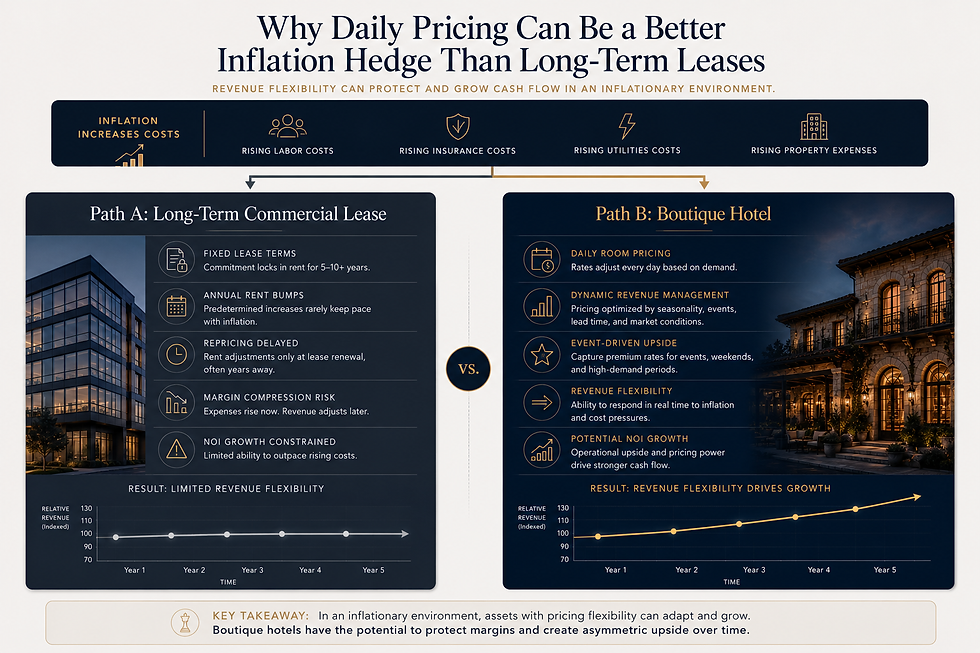
A commercial lease may reset once a year. A hotel room can reset every night.
That single difference changes the investment profile.
In many commercial real estate assets, the landlord signs long-term leases with fixed annual rent escalations. Those escalations might be 2%, 3%, or tied to CPI with caps. That can provide stability, but it can also limit upside when inflation, demand, or market rents move faster than the lease allows.
Hotels are different.
A hotel sells perishable inventory every night. If tonight’s room goes unsold, that revenue is gone forever. But if demand is strong, the hotel can raise rates immediately. Pricing can respond to:
Local events
Seasonality
Weekend demand
Holiday travel
Compression from sold-out competitors
Group blocks
Weddings
Corporate demand
Weather patterns
Airline disruptions
Market-wide occupancy
Consumer willingness to pay
That is why hotel revenue management matters so much.
ADR, or average daily rate, measures the average room revenue earned per occupied room.
RevPAR, or revenue per available room, combines rate and occupancy into a broader revenue metric. Investopedia defines ADR as room revenue divided by rooms sold, and RevPAR as a measure calculated from room revenue relative to available rooms or by multiplying ADR by occupancy.
For LP investors, these metrics matter because they show how a hotel captures demand.
A commercial lease is often about contractual income.
A hotel is about pricing strategy.
That creates more volatility, but also more flexibility.
The commercial lease problem during inflation
Imagine owning a commercial property with a ten-year lease and 2.5% annual rent increases.
That may feel safe.
But what happens if insurance rises 18%? What happens if utilities rise 12%? What happens if labor, maintenance, taxes, and financing costs all move faster than rent?
The lease protects occupancy, but it may not fully protect purchasing power.
In inflationary periods, fixed income streams can lose real value. This is especially true when leases were signed before inflation accelerated.
The hotel advantage during inflation
A hotel does not have to wait years to discover market rent. It discovers market rent every day.
If demand supports a higher rate, a capable operator can adjust pricing quickly. If a local event compresses supply, rates can move immediately. If the property improves its reputation, design, photography, or guest experience, pricing can be tested in real time.
This does not eliminate expense pressure. Hotels also suffer from inflation. Labor, insurance, property taxes, utilities, food costs, supplies, and CapEx can all increase.
But hotels have one thing many leased assets do not:
Revenue flexibility.
That flexibility is the foundation of the inflation hedge thesis.
How Boutique Hotels Create Asymmetric Upside
Asymmetric upside means the potential reward is meaningfully greater than the capital at risk, assuming the investment is structured and executed well.
In boutique hotels, this upside usually does not come from one variable. It comes from stacking multiple value-creation levers.
1. Buying an underpositioned asset
Many boutique hotel opportunities begin with a property that has good bones but poor execution.
The location may be strong. The building may have character. The market may have demand. But the asset may be suffering from outdated rooms, weak branding, bad photography, poor revenue management, inconsistent service, or inefficient operations.
That is where an experienced operator can create value.
The goal is not simply to “renovate and hope.” The goal is to identify a gap between what the property currently earns and what it could earn under a better concept, better systems, and better management.
2. Repositioning the guest experience
A boutique hotel can often increase perceived value through targeted improvements:
Better room design
Improved bedding and lighting
Local art and materials
Stronger lobby experience
Outdoor gathering spaces
Food and beverage upgrades
Wellness amenities
Event programming
Improved signage and arrival sequence
Better photography and digital presence
Discipline is key.
Not every dollar of design spend creates return. Some improvements support ADR. Some simply make the owner feel good.
Good operators know the difference.
3. Improving revenue management
This is one of the most overlooked value-creation levers.
A hotel can be physically attractive and still leave money on the table if pricing is lazy.
Common revenue management problems include:
Static rates
Weak weekend premiums
Poor event pricing
Overreliance on OTAs
Failure to segment demand
Incorrect minimum-stay rules
Discounting too early
Not yielding rates upward as occupancy builds
Ignoring competitor compression
Poor group pricing
Revenue management is where hospitality starts to look very different from traditional real estate.
In multifamily, if market rent is $2,200, you are probably not charging $3,400 for Saturday night because a concert is in town.
In hotels, that is exactly the point.
4. Increasing direct bookings
Many hotels rely heavily on online travel agencies. OTAs can be useful, but they are expensive. Commission costs reduce net revenue.
A boutique hotel with a strong brand, direct booking strategy, email list, repeat guest base, and social presence can reduce distribution leakage.
This improves profitability even if gross revenue stays the same.
For LPs, this is important. A sponsor who only talks about ADR but ignores net revenue after commissions is not telling the full story.
5. Adding ancillary revenue
Boutique hotels often have more ability to monetize the full guest experience.
Potential ancillary revenue streams include:
Restaurant and bar revenue
Private events
Weddings
Corporate retreats
Wellness classes
Spa services
Pool passes
Day-use cabanas
Retail Local partnerships
Pet fees
Parking Premium room upgrades
Experiential packages
Not every property should have all of these. Overcomplication can hurt margins.
But the right ancillary revenue can increase total revenue per guest and make the asset more valuable.
6. Improving reviews and reputation
Reviews are revenue infrastructure.
A hotel with poor reviews may be forced to discount. A hotel with strong reviews can often command a premium.
This is not just about being nice to guests. It is about operational consistency.
Clean rooms. Fast communication. Accurate listings. Smooth check-in. Reliable maintenance. Thoughtful service recovery. Clear expectations.
These are basic, but they are not easy. In hospitality, consistency compounds.
7. Expanding margins through systems
The best hotel operators are not just creative. They are systematic.
They use technology, staffing models, SOPs, automation, reporting, and accountability to reduce operational drag.
That matters because revenue growth alone is not enough. If every new dollar of revenue comes with too much labor or overhead, NOI does not expand.
For investors, the real question is not just “Can revenue grow?”
The better question is:
How much of that revenue growth flows through to NOI?
Why Smaller, Design-Forward Assets Can Outperform Generic Hotels
There is a reason investors are paying more attention to boutique and lifestyle hospitality.
The modern traveler often wants something more specific than a clean room near the highway. In many markets, guests want character, walkability, food and beverage, wellness, outdoor space, design, and a sense of place.
That does not mean branded select-service hotels are bad investments. In some markets, they are excellent.
But boutique hotels have a different kind of upside.
Smaller assets can target specific demand
A 60-room boutique hotel does not need to appeal to everyone. It can win by being the obvious choice for a specific guest.
Examples:
Couples visiting a wine region
Wedding guests in a destination market
Affluent weekend travelers
Wellness retreat guests
Corporate offsite groups
Design-conscious leisure travelers
Parents visiting a college town
Outdoor recreation travelers
Food and beverage-driven travelers
This specificity can be an advantage.
Generic hotels often compete against every other generic hotel. Boutique hotels can create their own lane.
Design can create pricing power
Design is not a guarantee of returns, but it can support rate premiums when paired with the right market and operations.
A room that photographs well converts better online. A lobby that feels memorable can drive social sharing. A restaurant or bar can attract locals. Outdoor space can increase event revenue. Strong design can make a property feel scarce.
That scarcity can become pricing power.
Independent positioning can unlock flexibility
Some boutique hotels operate independently. Others use soft brands or lifestyle flags.
Independent properties may have more flexibility around design, programming, and brand voice.
Branded or soft-branded properties may benefit from reservation systems and loyalty distribution.
Neither is automatically better.
The right answer depends on the market, asset, business plan, operator capability, and investor objectives.
The LP Lens: What Are You Really Investing In?
When LPs evaluate boutique hotel deals, they should not think only in terms of the building.
You are investing in five things at once.
1. The real estate
The physical asset still matters.
Location, land value, zoning, replacement cost, barriers to entry, walkability, access, parking, room layout, building condition, and CapEx needs all affect value.
A great operator cannot fully overcome a bad location or structurally flawed asset.
2. The operating business
Hotels are operating businesses.
That means the sponsor must understand operator(s) dynamics, staffing, revenue management, housekeeping, maintenance, guest experience, vendor management, technology, accounting, insurance, and compliance.
This is where many passive investors underestimate the asset class.
A hotel can look like real estate in the offering memorandum, but perform like a business in real life.
3. The brand
For boutique hotels, brand is not just a logo.
Brand is the story the property tells the market. It affects rate, guest mix, direct bookings, social proof, partnerships, and exit value.
A clear brand answers:
Who is this hotel for? Why would they choose it? What emotion should the property create? What makes it hard to replicate? Why does it deserve a premium?
4. The revenue strategy
Revenue strategy is where the business plan becomes measurable.
LPs should understand:
Projected ADR
Projected occupancy
RevPAR assumptions
Seasonality Weekday versus weekend mix
Event demand
Group business
Direct versus OTA bookings
Ancillary revenue
Competitive set
Demand segmentation
If a sponsor cannot explain why guests will pay the projected rate, that is a red flag.
5. The exit buyer
Every deal should be underwritten with the exit in mind.
Who buys this asset after the business plan is complete?
A local operator? A regional hotel group? A private equity buyer? A family office? A lifestyle hospitality platform? A 1031 buyer? A brand looking for a foothold in the market?
The more institutional and financeable the cash flow becomes, the more attractive the asset may be at exit.
Boutique Hotels vs. Long-Term Commercial Leases
The comparison between boutique hotels and long-term leased commercial real estate is not about declaring one universally better.
It is about understanding tradeoffs.
Long-term leases offer stability
Commercial leases can provide predictable income. A strong tenant with a long lease can reduce revenue volatility. Lenders often like contractual income. Investors like clarity.
But that stability can come with constraints.
If rents are below market, the owner may be stuck. If expenses rise faster than escalations, margins compress. If the tenant has leverage, renegotiation can be painful. If the lease is long, upside may be delayed.
(NAIOP defines effective rent as a discounted and normalized rent measure, reflecting the way commercial real estate often evaluates income over a lease term rather than through daily market pricing).
Boutique hotels offer flexibility
Hotels are less contractually stable, but more responsive.
A hotel can raise rates when demand increases. It can change minimum stays. It can shift channel strategy. It can package experiences. It can alter staffing. It can adjust to seasonality. It can reposition.
This flexibility can be extremely valuable in markets with growing demand, limited supply, or strong event calendars.
The tradeoff: stability versus adaptability
Long-term leased assets often offer more income visibility.
Boutique hotels often offer more operating leverage.
For LPs, the question is not which is “safer” in the abstract.
The question is:
Which risk are you being paid to take?
A long-term lease may protect occupancy but limit upside.
A boutique hotel may create upside but require better execution.
Key Risks LPs Need to Understand Before Investing
A credible boutique hotel thesis must acknowledge risk.
Hospitality is not simple. Boutique hotels can outperform, but they can also disappoint when sponsors overestimate pricing power, underestimate expenses, or treat the property like a design project instead of an operating business.
Seasonality risk
Many boutique hotels operate in seasonal markets.
That can be fine if the underwriting reflects it. But seasonality can create cash flow pressure if the business plan assumes smooth monthly performance.
LPs should ask:
What percentage of annual revenue occurs in peak months? How does the property perform in shoulder seasons? What is the break-even occupancy? How much working capital is reserved? How does debt service coverage look in slower months?
Labor risk
Hotels require labor. Even technology-enabled hotels need people.
Housekeeping, maintenance, guest service, management, food and beverage, landscaping, accounting, and revenue management all require oversight.
Labor shortages, wage growth, turnover, and training issues can materially affect margins.
CapEx risk
Boutique hotel renovations can be expensive.
Older properties may have hidden issues: plumbing, electrical, HVAC, roofing, waterproofing, ADA compliance, fire systems, environmental concerns, structural repairs, or deferred maintenance.
A sponsor who underbudgets CapEx can destroy returns before operations ever stabilize.
Demand risk
Boutique hotels depend on demand.
That demand may come from leisure travel, events, corporate groups, weddings, outdoor recreation, universities, hospitals, or local attractions.
LPs should understand what actually fills the rooms.
“Great market” is not enough. The sponsor should be able to explain demand segmentation.
OTA dependence
Online travel agencies can drive occupancy, but at a cost.
If a hotel depends too heavily on OTAs, revenue may look healthy while net profitability suffers.
A strong boutique hotel strategy should include a path toward more direct bookings over time.
Revenue management risk
Poor pricing can quietly kill a hotel investment.
Rates that are too low leave money on the table. Rates that are too high can hurt occupancy and reviews. Bad restrictions can block demand. Weak event pricing can miss compression opportunities.
This is why hotel investing requires specialized expertise.
Overdesign risk
This is a real problem.
Some sponsors fall in love with the aesthetic and forget the math. Design should support revenue. It should not become an uncontrolled spending category.
Every major design decision should connect to rate, occupancy, guest satisfaction, operating efficiency, or exit value.
Sponsor execution risk
In boutique hotels, the sponsor matters enormously.
The same asset can perform very differently under two different operators.
LPs should spend as much time evaluating the sponsor’s operating capability as they do evaluating the property.
How We Evaluate Boutique Hotel Deals
When evaluating boutique hotel investments, we want to understand both the upside and the ways the deal can go wrong.
A strong business plan should survive uncomfortable questions.
Market demand
We want to know why guests are already coming to the market and whether that demand is durable.
Important demand drivers may include:
Tourism
Universities
Hospitals
Corporate travel
Weddings
Outdoor recreation
Entertainment venues
Drive-to leisure demand
Conferences
Food and beverage scene
Regional population growth
We are cautious when a business plan depends on creating demand from scratch.
Basis
Basis matters. A boutique hotel can be a great asset and still be a bad investment if purchased at the wrong price.
We look at basis relative to:
Replacement cost
Recent comparable sales
Stabilized NOI
CapEx needs
Room count
Land value Market
ADR
Exit cap rate assumptions
A good story does not fix a bad basis.
Current operational inefficiency
We like deals where there is a clear reason the property is underperforming.
Examples:
Poor revenue management
Weak branding
Deferred maintenance
Bad reviews that can be fixed
Outdated design
Inefficient staffing
Poor photography
Limited direct booking strategy
Untapped event revenue
Underutilized common areas
The best opportunities often come from operational problems that are fixable.
ADR and occupancy upside
We want to know whether projected ADR growth is realistic.
That means studying the competitive set, guest segment, seasonality, event calendar, market compression, and quality gap between the subject property and alternatives.
We are skeptical of underwriting that assumes large ADR increases without a clear reason guests will pay more.
CapEx scope
CapEx must be tied to the business plan.
We want to know:
What must be done immediately? What can wait? What improvements drive revenue? What improvements reduce expenses? What contingency is included? What is the timeline? Who is managing the renovation? What happens if costs exceed budget?
Labor model
Labor can make or break hotel NOI.
We want to understand:
Staffing structure
Management model
Housekeeping assumptions
Front desk model
Use of technology
Food and beverage labor
Maintenance plan
Payroll as a percentage of revenue
Seasonal staffing adjustments
Technology stack
Modern hotel operations require strong systems.
That may include:
Property management system
Revenue management system
Channel manager
Guest messaging platform
Smart access
Housekeeping/task management
Reputation management
Accounting/reporting tools
The goal is not to use technology for its own sake. The goal is consistency, speed, visibility, and margin control.
Exit strategy
We want to know what the asset looks like after execution.
Will it be easier to finance? Will it appeal to better buyers? Will NOI be more durable? Will the brand be transferable? Will the property have cleaner reporting? Will the CapEx story be complete?
A boutique hotel exit is strongest when the buyer sees a stabilized business, not just a renovated building.
Common Mistakes Investors Make With Boutique Hotel Deals
Mistake 1: Confusing aesthetics with economics
A beautiful hotel is not automatically a good investment.
Design matters, but it must be connected to revenue strategy. Investors should ask how design choices support ADR, occupancy, ancillary revenue, guest satisfaction, or exit value.
Pretty is not the same as profitable.
Mistake 2: Treating hotels like apartments
Hotels and apartments are very different.
Apartments rely on monthly leases and resident retention. Hotels rely on nightly demand, pricing, reviews, distribution, and service consistency.
A multifamily investor entering hospitality should respect the operational learning curve.
Mistake 3: Believing aggressive ADR projections
Projected rate growth should be justified.
LPs should ask:
What is the current ADR? What is the competitive set ADR? What will change after renovation? Which guests will pay the new rate? How does the property compare visually and experientially? What happens in the downside case?
Mistake 4: Ignoring distribution costs
Gross revenue is not enough.
If a large portion of bookings come from OTAs, commissions can reduce profitability. Direct booking strategy matters.
Mistake 5: Underestimating working capital needs
Hotels can have uneven cash flow, especially during renovation, ramp-up, or seasonal periods.
A deal with insufficient reserves may be fragile even if the long-term thesis is sound.
Mistake 6: Overlooking food and beverage complexity
Food and beverage can elevate a boutique hotel, but it can also drain margins.
A restaurant can make the hotel more desirable, but only if it is operated well. LPs should understand whether F&B is a profit center, amenity, leased operation, or strategic loss leader.
Mistake 7: Not diligencing the sponsor
In boutique hotels, sponsor capability is not optional.
The sponsor must understand both real estate and operations. LPs should look for discipline, transparency, reporting quality, conservative underwriting, and a clear operating plan.
What This Means for LP Investors
For LP investors, boutique hotels can be compelling because they combine hard-asset ownership with business-level upside.
But they require a different lens.
You are not just investing in square footage. You are investing in pricing power, guest experience, operational execution, and a sponsor’s ability to convert a physical asset into a hospitality business.
The best boutique hotel investments usually have several characteristics:
A strong or improving market
A differentiated property
A clear guest segment
A basis that allows for mistakes
A realistic CapEx plan
A credible ADR and occupancy story
A sponsor with operational capability
A thoughtful revenue management strategy
Adequate reserves
Multiple exit paths
The inflation hedge is real, but only when the operator can actually capture pricing power.
Daily pricing is an advantage only if demand exists and the operator knows how to yield it.
That is why the sponsor matters so much.
If you are evaluating whether boutique hotels belong in your portfolio, the next step is not chasing the highest projected IRR. It is understanding how the operator thinks about basis, downside protection, revenue management, and execution.
You can join our investor list to see how we evaluate hospitality opportunities and what we look for before pursuing a deal.
FAQs About Investing in Boutique Hotels
Is investing in boutique hotels risky?
Yes, boutique hotels carry risk. They are more operationally intensive than many traditional real estate assets. Revenue can fluctuate daily, labor matters, reviews matter, and execution is critical. However, that operational complexity is also what creates upside when a property is acquired at the right basis and improved by a capable operator.
Why can boutique hotels be an inflation hedge?
Boutique hotels can be an inflation hedge because they have the ability to adjust room rates daily. Long-term commercial leases may only increase annually or at fixed percentages, while hotel pricing can respond quickly to demand, inflation, events, and market compression. This flexibility does not eliminate rising expenses, but it gives hotels a revenue lever many leased assets do not have.
How do boutique hotels make money?
Boutique hotels primarily make money from room revenue, but they may also generate income from food and beverage, events, weddings, retreats, parking, resort fees, retail, wellness services, and other guest experiences. The best boutique hotel strategies focus on both revenue growth and NOI flow-through.
What is ADR?
ADR stands for average daily rate. It measures the average room revenue earned for each occupied room. ADR is one of the core metrics used to evaluate hotel pricing performance.
What is RevPAR?
RevPAR stands for revenue per available room. It combines rate and occupancy into one metric and helps investors understand how efficiently a hotel is generating room revenue from its available inventory.
Are boutique hotels better than multifamily?
Not necessarily. Boutique hotels and multifamily serve different roles in a portfolio. Multifamily may offer more stable tenant demand and longer lease visibility. Boutique hotels may offer greater pricing flexibility and operational upside. The better investment depends on the deal, market, sponsor, risk profile, and investor goals.
What should LP investors look for in a boutique hotel sponsor?
LPs should look for a sponsor with hospitality operating experience, conservative underwriting, clear reporting, disciplined CapEx planning, strong revenue management, adequate reserves, and a realistic understanding of downside risk. In boutique hotels, the sponsor’s execution ability is one of the most important parts of the investment.
What makes a boutique hotel investment fail?
Common causes include overpaying, underestimating CapEx, weak revenue management, poor operations, bad reviews, overdependence on OTAs, insufficient reserves, unrealistic ADR assumptions, poor market selection, and sponsors who treat the hotel like a design project instead of an operating business.
Can LP investors invest passively in boutique hotels?
Yes, LP investors can invest passively through syndications, funds, or private offerings. However, the underlying asset is actively operated. LPs are passive at the ownership level, but they are relying heavily on the sponsor and operator to execute the business plan.
What is asymmetric upside in boutique hotel investing?
Asymmetric upside means the potential reward may be disproportionately high relative to the invested capital if the business plan succeeds. In boutique hotels, this can happen when a sponsor buys an underperforming asset, improves design and operations, increases ADR, strengthens margins, and exits at a higher valuation.
Final Thoughts: Boutique Hotels Reward Operators, Not Tourists
Boutique hotels are not attractive simply because they are charming.
They are attractive when the investment thesis is disciplined.
The real opportunity is not buying a cool building and hoping travelers show up. The opportunity is buying an asset where the current performance does not reflect the true potential of the location, design, operations, pricing strategy, and guest experience.
That is where asymmetric upside can exist.
But LPs should be selective.
Hospitality rewards operators who understand both the art and the math. The art is brand, design, experience, and emotional connection. The math is basis, ADR, occupancy, margin, CapEx, reserves, debt, and exit value.
When those two sides come together, boutique hotels can become one of the more interesting real estate investment strategies available to passive investors.
They offer something many long-term leased assets cannot:
The ability to adapt quickly.
In a world where costs move fast, demand shifts fast, and travelers make decisions in real time, that adaptability can be a serious advantage.
If you are interested in investing alongside operators who evaluate boutique hotels through both a real estate and operating-business lens, join our investor list or schedule a conversation with Liz or Tom.
We focus on opportunities where the upside is not based on hype, but on disciplined acquisition, thoughtful repositioning, operational improvement and clear investor communication.
(Disclaimer: This article is for educational purposes only and should not be considered financial, legal, or tax advice. Real estate investments involve risk, including loss of principal. Always consult your own CPA, attorney, financial advisor, and other professionals before making investment decisions).


Comments