The Truth About Passive Income in Commercial Real Estate


“Passive income” might be one of the most overused phrases in real estate.
It sounds clean. Easy. Almost automatic.
Invest money. Sit back. Collect checks. Build wealth.
That version is attractive, but it is not the full truth.
Passive income in commercial real estate does exist. But it is not risk-free, responsibility-free, or guaranteed. It is not the same as doing absolutely nothing. And it should not be treated like a lottery ticket, a crypto moonshot, or a once-in-a-lifetime “get in now or miss out forever” opportunity.
The better way to think about passive commercial real estate investing is this:You are not buying effortless income. You are deploying capital into a business plan, backed by real assets, operated by people you trust to execute.
That distinction matters.
Because the investors who do well in commercial real estate usually are not the ones chasing the flashiest projected return. They are the ones who understand the fundamentals, evaluate the operator, respect the risks, and stay disciplined over a long enough time horizon for the strategy to actually work.
This guide is written for the person considering their first commercial real estate investment as a limited partner, also known as an LP.
Maybe you are a W-2 professional, business owner, accredited investor, or someone who has owned a rental or two and wants exposure to larger assets without taking on the day-to-day work yourself.
If that is you, passive investing can be powerful but only if you understand what “passive” really means.
What is passive income in commercial real estate?
Passive income in commercial real estate usually refers to income earned by an investor who contributes capital to a commercial real estate deal but does not manage the property or execute the business plan. The investor often participates as a limited partner, while the sponsor or general partner handles acquisition, financing, operations, asset management, investor communication, and exit strategy. Passive CRE income can come from operating cash flow, refinance proceeds, sale proceeds, or other distributions, but it is not guaranteed and depends on actual deal performance.
Considering passive commercial real estate investing but still learning how LP deals work? Join the Bono Capital Group investor list for educational updates, deal insights, and our perspective on hospitality-focused real estate opportunities.
Table of Contents
What Passive Income in Commercial Real Estate Actually Means
Why Commercial Real Estate Is Different From Residential Investing
Our Experience: When “Passive Income” Required Very Active Execution
What to Understand About Timelines, Distributions, and Exits
Final Thoughts: Passive Income Is Real, But It Must Be Earned
What Passive Income in Commercial Real Estate Actually Means
In commercial real estate, passive income usually refers to income earned by an investor who contributes capital to a deal but does not manage the property or execute the business plan.
Most commonly, that person invests as a limited partner, or LP.
The LP provides capital. The sponsor or general partner, often called the GP, finds the deal, structures the investment, secures financing, manages the asset, oversees the renovation or repositioning, communicates with investors, and ultimately works to execute the business plan.
In theory, the LP is passive because they are not dealing with tenants, vendors, contractors, lenders, property managers, payroll, bookings, leases, or daily operations.
But passive does not mean uninvolved.
A passive investor still has responsibilities before, during, and after investing.
Before investing, you need to understand the deal, review the business plan, assess the risks, evaluate the sponsor, and decide whether the investment fits your financial goals.
During the hold period, you should track updates, monitor distributions, review reports, ask informed questions, and stay aware of how the asset is performing against the original plan.
After the investment ends, you should evaluate the outcome, review your own decision-making, and use the experience to become a better investor. That is the real version of passive investing.

You are not running the deal, but you are still responsible for where you place your capital.
Passive Does Not Mean Doing Nothing
One of the biggest myths about passive income is that it requires no work at all.
That is not true.
If you want to be completely passive from an operational standpoint, investing as an LP may be the right structure. But the tradeoff is that you are trusting someone else to execute.
That means your work shifts from “managing the asset” to “choosing the right asset, operator, and opportunity.”
A good LP does not need to be an expert in every detail of commercial real estate. But they should understand the basics well enough to ask better questions.
At a minimum, a passive investor should understand:
What type of asset they are investing in.
How the property currently makes money.
How the sponsor plans to improve performance.
What assumptions drive the projected returns.
What could go wrong.
How the sponsor plans to mitigate risk.
How investor capital is protected.
When distributions are expected.
What happens if the deal underperforms.
How and when the sponsor plans to exit.
This does not mean you need to become the operator. It means you need to be an informed capital partner.
The most dangerous version of passive investing is not trusting a sponsor.
The most dangerous version is blindly trusting a sponsor without understanding the deal.
Why Commercial Real Estate Is Different From Residential Investing
Many investors start with residential real estate because it is easier to understand.
A single-family rental is usually valued based on comparable sales. If similar homes in the neighborhood are selling for $300,000, your property is likely worth something close to that, assuming condition and location are similar.
Commercial real estate is different.
Commercial properties are often valued based on net operating income, or NOI.
That means the value of the asset is directly tied to how much income the property produces after operating expenses, before debt service. This creates both opportunity and responsibility.
In residential real estate, you may be more limited by neighborhood comps. In commercial real estate, the operator may have more levers to pull. For example, in a hotel or motel investment, revenue may not be limited to room rates alone. A strong operator may be able to add or improve revenue streams such as food and beverage, vending, events, amenity rentals, early check-in fees, late checkout fees, parking, partnerships, corporate stays, or group bookings.
In other commercial assets, value may be created through lease-up, expense control, better management, improved tenant mix, renovations, repositioning, operational efficiencies, or new business lines.
That is one of the reasons we were drawn to commercial real estate. It allows for creativity.
You are not just hoping the market goes up. You can potentially improve the asset’s performance by improving how the asset operates.
But that also means execution matters.
A commercial real estate deal is not just a property. It is a business plan attached to a property.
The Real Wealth Driver: NOI, Not Hype
Projected returns can be exciting.
IRR. Equity multiple. Cash-on-cash return. Preferred return. Refinance proceeds. Sale proceeds. These numbers matter, but they should not be the first thing a passive investor falls in love with.
A beautiful projection does not create wealth by itself. Execution does.
Commercial real estate wealth is often generated by increasing NOI, protecting the downside, managing debt correctly, improving the asset, and exiting at the right time.
A simple way to think about it is this:
If NOI increases and the market supports the valuation, the property may become more valuable.
That is why commercial real estate can be powerful. But it is also why unrealistic assumptions can be dangerous. If the sponsor assumes aggressive rent growth, huge occupancy gains, major expense reductions, or a perfect exit cap rate, the projected returns may look great on paper while being fragile in real life.
New LPs should pay close attention to what has to happen for the deal to work.
Does the business plan require modest improvement, or does everything have to go perfectly? Is the asset already performing, or is the sponsor trying to turn around a struggling property? Is there real demand in the market, or is the strategy based on wishful thinking? Are there multiple ways to win, or only one narrow path?
The return projection is the output.
The business plan is the input.
Do not evaluate the output without understanding the input.
Why NOI matters in commercial real estate
Net operating income, or NOI, is the income a commercial property generates after operating expenses but before debt service. Because many commercial properties are valued based on income, increasing NOI may increase the value of the property if the market supports the valuation. That is why operational improvements, revenue growth, expense control, and better management can be major drivers of commercial real estate returns.
Our Experience: When “Passive Income” Required Very Active Execution
One of the clearest lessons we have learned is that passive income for investors is often powered by very active work behind the scenes.
In one of our projects, we converted the use of a building and essentially started a new business from scratch.
That was the business plan from the beginning. We understood that the opportunity was not just in owning the real estate, but in repositioning how the asset functioned and how it generated income.
From the outside, the finished product may have looked like a passive income asset.
But the process to get there was anything but passive. There was upfront planning. There were operational decisions. There were design choices. There were systems to build, vendors to coordinate, processes to create, and a launch to prepare for.
We spent nearly a month living in the building before opening so we could get it set up correctly. That kind of work is not always visible to passive investors. But it is often the difference between a business plan that sounds good and a business plan that actually has a chance to work.
This is especially true in operationally intensive asset classes like hospitality.
A hotel is not just a building with rooms. It is a business.
You need pricing strategy, guest experience, housekeeping systems, maintenance processes, revenue management, technology, staffing, vendor relationships, reviews, and brand positioning.
The LP may not be doing those things personally.
But they need to understand that someone has to.
That is why operator quality matters so much.
What New LPs Should Evaluate Before Investing
Before investing passively in commercial real estate, new LPs should slow down and evaluate the deal from multiple angles.
The goal is not to eliminate all risk. That is impossible. The goal is to understand the risk you are taking, why you are taking it, and whether the potential reward justifies it.
Here are the major categories to evaluate.
Location
Location still matters. In fact, it may matter even more than the projected return numbers.
Ask:
Is the property in a strong location?
Is the neighborhood improving, stable, or declining?
Are there demand drivers nearby?
Is there population growth, job growth, tourism, infrastructure investment, or business expansion?
Is the property located in an opportunity zone?
Are major developments coming to the area?
Is there a reason demand may increase over time?
For example, if a major destination like Buc-ee’s is being built nearby, that could create additional traffic, jobs, visibility, and demand in a market. That does not automatically make a deal good, but it is the type of demand driver investors should pay attention to.
The key question is simple: Why this asset, in this location, at this time?
Basis
Basis means what you are paying for the asset relative to its current condition, income, replacement cost, and future potential.
A good asset at a bad basis can become a bad investment. A challenging asset at the right basis may create opportunity.
New LPs should ask:
Is the sponsor buying the asset at a reasonable price?
Is there room in the basis to handle surprises?
How does the purchase price compare to similar assets?
Would the deal still make sense if the business plan takes longer than expected?
Current Performance
Understand how the property performs today before focusing on how it might perform tomorrow.
Ask:
What is the current revenue?
What is the current NOI?
What are the current expenses?
Is the asset stabilized or distressed?
Are there operational problems?
Are there deferred maintenance issues?
What is the gap between current performance and projected performance?
A business plan based on modest improvement is very different from one that requires a complete turnaround.
Neither is automatically wrong, but they carry different risks.
Business Plan
The business plan should be specific and believable.
“Improve operations” is not enough.
A stronger business plan explains exactly how the sponsor intends to improve performance.
That could include renovations, lease-up, better management, expense control, new revenue streams, rebranding, repositioning, technology upgrades, improved pricing, or a more efficient staffing model.
A new LP should ask:
What exactly is the sponsor going to do?
How much will it cost?
How long will it take?
Who is responsible for execution?
What happens if costs are higher than expected?
What happens if revenue growth is slower than expected?
Debt
Debt can help amplify returns, but it can also create risk.
New LPs should understand the financing structure.
Ask:
Is the debt fixed rate or floating rate?
When does the loan mature?
Are there extension options?
Is there a refinance assumption?
What happens if interest rates are higher at refinance?
What debt service coverage ratio is required?
Does the sponsor have enough reserves?
Many deals get into trouble not because the real estate is worthless, but because the capital structure is too tight.
Reserves
Reserves are not exciting, but they are important.
A deal with no cushion is vulnerable.
Ask:
How much working capital is being raised?
Are there reserves for construction overruns?
Are there reserves for operating shortfalls?
Are there reserves for debt service?
How long can the property operate if the business plan is delayed?
If a sponsor treats reserves like an afterthought, that is a concern.
Exit Strategy
Every deal should have a clear exit strategy, but investors should remember that exit timing can change.
Ask:
Is the plan to sell, refinance, or hold long term?
What year is the expected exit?
What assumptions are being used for the exit valuation?
What happens if market conditions are not favorable at that time?
Can the asset support a longer hold if needed?
A strong sponsor does not just have a best-case exit plan.
They have options.
How to Vet the Sponsor or Operator
In passive investing, the sponsor is one of the most important parts of the deal.
You are not just investing in a property. You are investing with people.
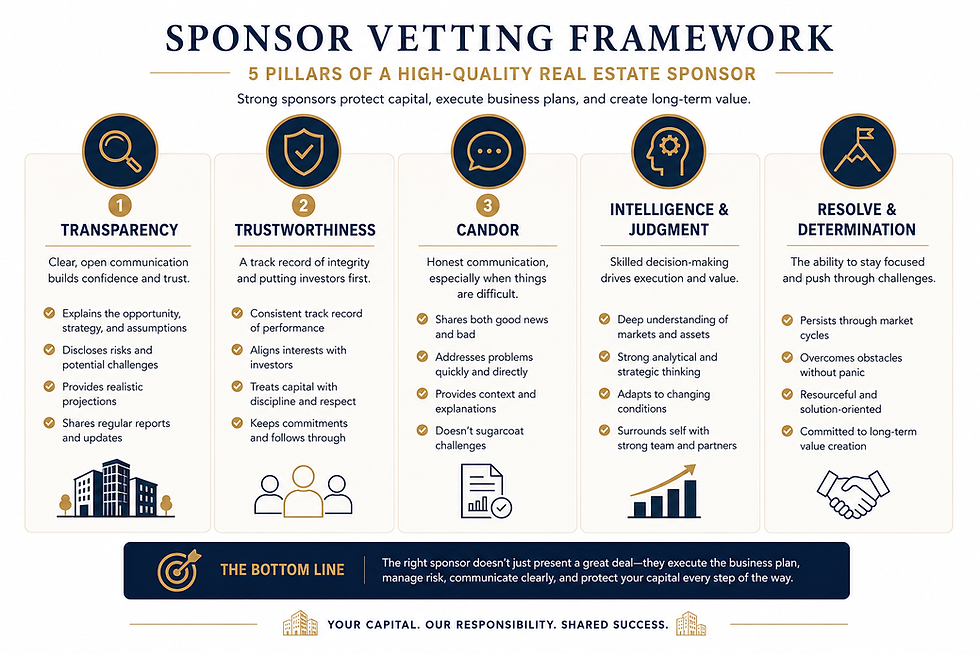
The sponsor is responsible for sourcing the deal, structuring the investment, managing the asset, communicating with investors, handling problems, and making key decisions when conditions change.
That is why sponsor evaluation should go beyond resume credentials. Experience matters, but character matters too.
Here are the qualities we believe passive investors should look for.
Transparency
A good sponsor is clear about the opportunity, the risks, the assumptions, and the unknowns. They do not pretend every deal is perfect. They explain what could go wrong and how they plan to respond.
Trustworthiness
Trust is built through consistency.
Does the sponsor do what they say they will do?
Are they responsive?
Do they provide information clearly?
Do they avoid overpromising?
Do they treat investor capital with seriousness?
Candor
Candor is underrated.
You want a sponsor who tells the truth even when the truth is inconvenient.
If a deal is delayed, expenses increase, financing changes, or distributions are paused, investors deserve direct communication.
A sponsor who only communicates when things are going well may not be the person you want operating your capital.
Intelligence and Judgment
Commercial real estate involves constant decision-making. The sponsor needs to understand markets, financing, operations, risk, people, timing, and execution.
But intelligence alone is not enough.
Judgment is what matters when the spreadsheet meets reality.
Resolve and Determination
Every deal has problems. Permits get delayed. Contractors miss deadlines. Interest rates move. Expenses rise. Revenue ramps slower than expected. Lenders change terms.
Markets soften.
A good sponsor does not panic when the road gets curvy. They adapt, communicate, and keep moving. That resolve is hard to quantify, but it matters.
Interested in passive commercial real estate exposure without becoming the operator? Join the Bono Capital Group investor list or schedule a conversation with Liz or Tom to learn how we evaluate hospitality-focused opportunities and communicate with LP investors.
Common Red Flags in Passive CRE Deals
New LPs do not need to be cynical, but they should be alert.
Here are some common red flags to watch for.
The Returns Look Too Optimistic
High projected returns are not automatically bad. But the higher the return, the more important it is to understand what assumptions support it.
Ask:
What has to happen for these returns to be achieved?
Are rent growth, occupancy, ADR, NOI, or exit assumptions realistic?
Is the sponsor showing sensitivity analysis?
What happens in a downside case?
If the deal only works in the best-case scenario, be careful.
There Is No Clear Risk Mitigation Plan
Every investment has risk. The issue is not whether risk exists. The issue is whether the sponsor has identified it and planned for it.
Ask:
What are the top risks in this deal?
How are they being mitigated?
What is the contingency plan?
What happens if the renovation takes longer?
What happens if the refinance does not happen?
What happens if distributions are delayed?
A sponsor who says, “There really is not much risk,” is not being realistic.
The Team Lacks Relevant Experience
Experience should match the business plan.
If the strategy is a hotel turnaround, does the team understand hospitality operations?
If the strategy is a heavy renovation, does the team have construction experience?
If the strategy depends on leasing, does the team have leasing expertise?
If the sponsor is newer, have they surrounded themselves with experienced partners, advisors, property managers, lenders, attorneys, or operators?
No one starts with decades of experience. But investors should understand who is actually responsible for execution.
The Business Plan Feels Vague
A vague plan is a problem.
Look out for language like:
“We will improve management.”
“We will increase revenue.”
“We will cut expenses.”
“We will renovate and raise rents.”
Those ideas may be valid, but they need details.
How? By how much?At what cost? Over what timeline? Based on what evidence?
Executed by whom?
The Sponsor Avoids Questions
A good sponsor should welcome thoughtful questions.
They may not have every answer immediately, but they should be willing to explain the deal, provide backup, and help investors understand the opportunity.
If basic questions are treated like an inconvenience, that is a red flag.
The Deal Uses Pressure Instead of Education
Be cautious with artificial urgency. There may be real deadlines in a deal, but investors should not feel manipulated.
Commercial real estate is not pre-IPO Uber. It is not a meme coin. It is not a “wire today or regret it forever” opportunity.
There is always another deal. A good sponsor would rather have aligned investors than rushed investors.
What to Understand About Timelines, Distributions, and Exits
Commercial real estate is a long-term wealth-building strategy. It does not happen overnight.
Many passive investments have projected hold periods of three, five, seven, or even ten years. During that time, returns may come from several sources:
Operating cash flow.
Refinance proceeds.
Appreciation.
Sale proceeds.
But those returns are dependent on actual results, not just projections.
The path is rarely a straight line.
A property may take longer to renovate than expected. Revenue may grow slower than projected. Distributions may start later than planned. A refinance may be delayed.
A sale may happen earlier or later depending on market conditions.
This does not automatically mean the deal is failing. It means real estate is real.
New LPs should expect a curvy road, not a perfect one. That is especially important when thinking about distributions.
Some deals may offer distributions early. Others may intentionally delay distributions while the sponsor renovates, stabilizes, leases up, or repositions the asset.
The question is not simply, “When do I get paid?”
The better question is: What needs to happen operationally before the asset can responsibly distribute cash?
A sponsor should be able to explain that clearly.
When You Should Not Invest in a Passive CRE Deal
Sometimes the best investment decision is to wait.
That may not be what people want to hear, but it is important.
You should be cautious about investing in a passive commercial real estate deal if you need the money in the near future.
If tying up capital for three to seven or more years would create stress, pressure, or financial instability, it may not be the right time.
Commercial real estate is generally illiquid. You cannot assume you will be able to sell your LP interest quickly. You cannot assume you will get your capital back early. You cannot assume distributions will arrive exactly as projected.
This type of investing is better suited for capital that can remain invested for the full business plan. That does not mean you need to be ultra-wealthy to learn about the space.
It means you should be honest about your liquidity needs. If you need the money, do not tie it up in a long-term deal.
Wait until you can. There will be another opportunity.
A Simple LP Due Diligence Checklist
Before investing in a passive commercial real estate deal, use this checklist as a starting point.
Deal Basics
What asset class is this?
Where is the property located?
Why is this location attractive?
What is the purchase price?
What is the total project cost?
How much equity is being raised?
What is the minimum investment?
What is the projected hold period?
Market and Location
Is the property in a good neighborhood or submarket?
Are there strong demand drivers nearby?
Is the area growing?
Are there new developments, employers, tourism drivers, infrastructure improvements, or demographic trends supporting the thesis?
Is the property in an opportunity zone?
What are the risks specific to this market?
Business Plan
What is the sponsor planning to do?
Is this a stabilized deal, value-add deal, development deal, or turnaround?
What improvements are required?
How much capital is allocated to the plan?
What is the timeline?
What assumptions drive the returns?
What happens if the plan takes longer?
Financials
What are the projected returns?
What are the current financials?
What is the projected NOI?
How does the sponsor plan to increase income or reduce expenses?
Are the assumptions realistic?
Is there a sensitivity analysis?
What does the downside case look like?
Debt and Capital Structure
What type of debt is being used?
Is the rate fixed or floating?
When does the loan mature?
Are there extension options?
Is the deal dependent on a refinance?
What happens if refinance proceeds are lower than expected?
How much reserve capital is included?
Sponsor and Team
Who is the sponsor?
What is their experience?
Have they executed similar business plans?
Who is handling operations?
Who is handling construction or renovations?
Who is managing the property?
How does the sponsor communicate with investors?
Are they direct about risks?
Legal and Investor Terms
What type of offering is this?
What are the investor rights?
What fees does the sponsor earn?
Is there a preferred return?
How are profits split?
When are distributions expected?
What are the major risks listed in the documents?
Have you reviewed the PPM, operating agreement, and subscription documents?
Have you consulted your own legal, tax, or financial advisors if needed?
Personal Fit
Can you afford to have this capital tied up for the full hold period?
Does this deal fit your risk tolerance?
Do you understand how the investment works?
Do you trust the sponsor?
Are you comfortable with the business plan?
Would you still be comfortable if distributions were delayed?
If the answer to any of these questions is no, slow down. Being overly cautious is okay.
There is always another deal.
Final Thoughts: Passive Income Is Real, But It Must Be Earned
Passive income in commercial real estate is real but it needs to be better defined.
It is not magic. It is not effortless. It is not guaranteed. And it is not something investors should enter blindly because the projected returns look attractive.
The better version of passive investing is disciplined capital deployment. You do your homework. You understand the fundamentals. You evaluate the location, the asset, the business plan, the risks, and the sponsor. You invest with people you trust. Then you let the operator do their job while holding them accountable through communication, reporting, and performance.
That is the balance.
You do not need to control every decision but you should understand what you own.
You do not need to operate the asset but you should know who is operating it.
You do not need to be afraid of risk but you should know what risks you are taking.
Commercial real estate can be an incredible tool for long-term wealth preservation and growth. It can provide income, appreciation, tax advantages, diversification, and access to larger assets than many investors could buy alone.
But it rewards patience, discipline, and good judgment.
Not hype. Not shortcuts. Not blind trust.
If you are new to passive commercial real estate investing, the goal is not to become an expert overnight. The goal is to become informed enough to make better decisions.
You can do this if you really want to. Just do your homework, understand the fundamentals, trust the sponsor and the plan, let the sponsor execute, and do not be afraid to hold them accountable.
FAQ: Passive Income in Commercial Real Estate
Is commercial real estate passive income actually passive?
It can be passive from an operational standpoint if you invest as a limited partner. However, passive does not mean you do nothing. You still need to understand the deal, evaluate the sponsor, review the risks, monitor performance, and track communications.
Can you lose money as a passive investor in commercial real estate?
Yes. Passive commercial real estate investments involve risk, including loss of principal. Your capital may be affected by poor execution, market changes, financing issues, construction delays, tenant problems, lower-than-expected income, or a weak exit market.
What is an LP in commercial real estate?
An LP, or limited partner, is a passive investor who contributes capital to a deal but does not manage the property or make day-to-day operational decisions. The sponsor or general partner is responsible for executing the business plan.
What should I look for before investing in a commercial real estate deal?
You should evaluate the location, basis, current financials, business plan, debt structure, reserves, sponsor experience, risk mitigation plan, investor terms, and whether the deal fits your personal liquidity needs and risk tolerance.
What is more important: the projected return or the sponsor?
Both matter, but the sponsor is critical. A strong projection means very little if the sponsor cannot execute. Look for transparency, trustworthiness, candor, relevant experience, judgment, and resolve.
How long does it take to make money from passive commercial real estate?
It depends on the deal. Some investments may generate cash flow relatively early, while others may delay distributions during renovation, lease-up, repositioning, or stabilization. Many commercial real estate investments have projected hold periods of three to seven or more years.
Are high projected returns a red flag?
Not always, but they should be examined carefully. High returns may come with higher risk or aggressive assumptions. Investors should understand what has to happen for the returns to be achieved and what the downside case looks like.
Should I invest if I might need the money soon?
Generally, no. Passive commercial real estate investments are usually illiquid and can tie up capital for years. If you need the money for living expenses, emergencies, a home purchase, or near-term obligations, it may be better to wait.
What questions should I ask a sponsor?
Ask about their experience, the business plan, projected returns, risks, downside scenarios, debt terms, reserves, communication process, fees, exit strategy, and what happens if the deal underperforms.
Is passive commercial real estate investing good for beginners?
It can be, but beginners should move carefully. Start by learning the fundamentals, reviewing deals, asking questions, understanding risks, and only investing capital they can afford to have tied up for the full projected hold period.
Interested in passive commercial real estate exposure without becoming the operator? Join the Bono Capital Group investor list or schedule a conversation with Liz or Tom to learn how we evaluate hospitality-focused opportunities and communicate with LP investors.
(Disclaimer: This article is for educational purposes only and should not be considered financial, legal, tax, or investment advice. All investments involve risk, including potential loss of principal. Passive real estate investments are often illiquid, may not produce expected distributions, and may be suitable only for certain investors. Always consult with your attorney, CPA, financial advisor, and other professionals before making any investment decision).



Comments