How to Understand Equity Multiple in Real Estate Investing

A beginner-friendly guide for passive investors reviewing real estate deal projections

When a passive investor reviews a real estate investment opportunity for the first time, one of the first numbers they usually notice is the equity multiple.
You might see a sponsor project a 1.6x, 1.8x, or 2.0x equity multiple.
At first glance, the bigger number may seem better. But equity multiple does not tell the full story by itself.
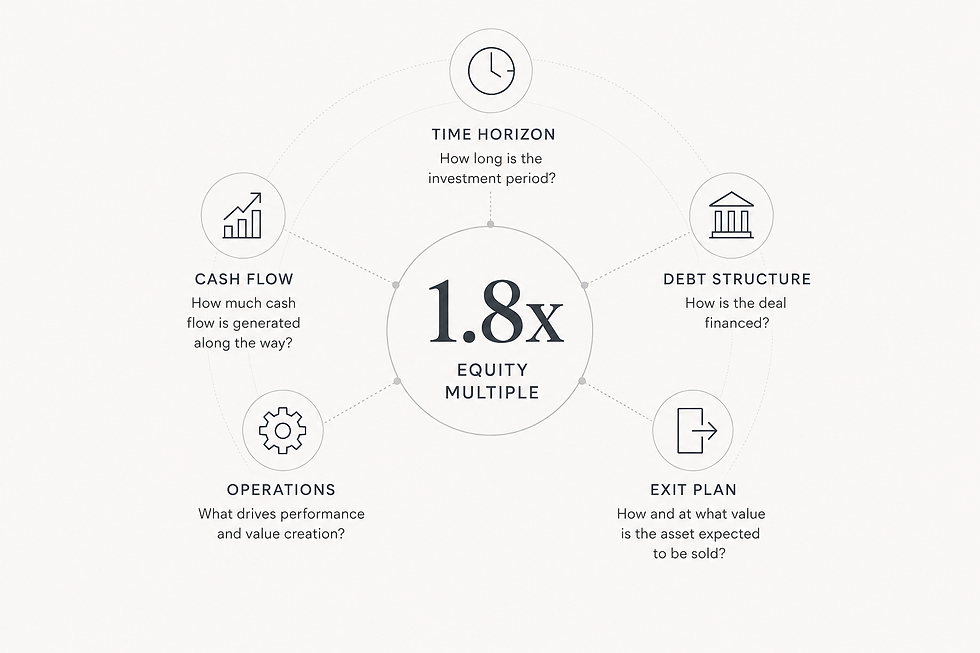
A 2.0x equity multiple over 10 years is very different from a 2.0x equity multiple over 4 years. A deal that returns most of the money at sale is different from a deal that distributes steady cash flow along the way. A higher projected equity multiple may also come with higher leverage, heavier renovation risk, or more aggressive exit assumptions.
At Bono Capital Group, we believe equity multiple is a helpful place to start when analyzing a deal — but it should lead to better questions, not automatic conclusions.
This article gives newer passive investors a simple foundation for understanding equity multiple, why it matters, how to calculate it, and what to ask before relying on it.
What Is Equity Multiple?
Equity multiple measures how much total money an investor is projected to receive compared with how much they originally invested.
The basic formula is:
Equity Multiple = Total Distributions Received ÷ Original Equity Invested
For example, if you invest $100,000 and receive $180,000 back over the life of the deal, your equity multiple is:
$180,000 ÷ $100,000 = 1.8x
That means you received your original capital back plus an additional $80,000 in profit.
Equity multiple is useful because it helps investors understand the potential total return of a real estate investment. But it does not show how long the investment takes, when the cash is received, or how much risk is involved in achieving that return.
Table of Contents
What Equity Multiple Means
Equity multiple answers one simple question:
For every dollar I invest, how many dollars am I expected to get back?
A 1.0x equity multiple means you got your original investment back, but no profit.
A 1.5x equity multiple means you received 1.5 times your original investment.
A 2.0x equity multiple means you doubled your original investment.
Here is a simple table:

Equity multiple is commonly used in private real estate investments, syndications, commercial real estate deals, hospitality projects, and value-add investment opportunities.
It gives investors a quick way to compare the total projected return across different opportunities.
But “quick” does not mean “complete.”
How to Calculate Equity Multiple
The formula is simple:
Equity Multiple = Total Cash Received ÷ Total Equity Invested
“Total cash received” includes all distributions paid to the investor during the investment period, including:
Operating cash flow distributions
Refinance proceeds, if any
Sale proceeds
Return of original capital
Profit distributions
For example:
An investor contributes $100,000 to a real estate deal.
Over the life of the investment, they receive:

The equity multiple would be:
$180,000 ÷ $100,000 = 1.8x
That 1.8x number means the investor received 1.8 times their original investment.
It does not mean the investor earned 80% per year.
It means the investor received an 80% total profit over the full investment period.
That distinction matters.
Why Equity Multiple Matters
Equity multiple matters because it gives passive investors a simple way to understand the total return potential of a deal.
When you are reviewing a private real estate investment, you may see several projected metrics at once:
Equity multiple
Internal rate of return, or IRR
Average annual return
Cash-on-cash return
Preferred return
Target hold period
Projected sale price
That can feel overwhelming for a newer investor.
Equity multiple is often one of the easiest metrics to understand because it speaks in plain terms:
“How much total money could I receive compared with what I put in?”
That is why we see it as a strong starting point. But it should be the start of the analysis, not the end.
A projected equity multiple can look attractive on paper while still depending on assumptions that may or may not happen.
For example:
The property may need to hit certain rent growth targets.
Renovations may need to stay on budget.
Occupancy may need to improve.
Interest rates may need to cooperate.
The exit cap rate may need to be realistic.
The market may need to support the projected sale price.
The number is only as strong as the business plan behind it.
Why Time Horizon Changes Everything
One of the biggest things newer investors need to understand is that equity multiple does not tell you how long it takes to earn the return.
That is why the project horizon matters.
A 2.0x equity multiple sounds great. But the meaning changes depending on the hold period.
All three deals show the same equity multiple, but they are not the same investment experience.

The 4-year deal returns capital much faster. The 10-year deal ties up capital for much longer.
Depending on the investor’s goals, liquidity needs, risk tolerance, and opportunity cost, one may be more attractive than the other.
This is why we believe investors should always ask:
“Over what period of time is this equity multiple projected?”
A projected 1.7x over 3 years may be more compelling than a projected 2.0x over 8 years, depending on the risk profile and assumptions.
The time horizon gives the number context. Without it, equity multiple can be misleading.
Equity Multiple vs. IRR vs. Cash-on-Cash Return
Equity multiple is helpful, but it should be compared with other return metrics.
Each metric tells a different part of the story.
Metric | What It Tells You | What It Does Not Tell You |
Equity Multiple | Total projected return over the life of the investment | Timing of cash flows |
IRR | Annualized return that accounts for timing | Can be influenced by early distributions or quick exits |
Cash-on-Cash Return | Annual cash flow compared with invested capital | Total profit at sale |
Average Annual Return | Simple average yearly return | Does not fully account for timing |
Preferred Return | Priority return paid before sponsor participation, if applicable | Not guaranteed and depends on deal performance |
A newer investor may be tempted to look for the highest IRR or highest equity multiple.
A better approach is to ask how the metrics work together.
For example:
A deal with a high IRR but low equity multiple may return money quickly but not create as much total profit.
A deal with a high equity multiple but low annual cash flow may rely heavily on the sale.
A deal with steady cash-on-cash returns may be attractive for income-focused investors, even if the final equity multiple is more moderate.
A deal with a high projected equity multiple may carry more execution risk.
Equity multiple gives you the big-picture total return.
IRR gives you timing sensitivity.
Cash-on-cash return gives you annual income context.
None of them should be viewed alone.
A Simple BCG-Style Example
Let’s use a simplified educational example.
An investor puts $100,000 into a private real estate investment, the projected hold period is 5 years. During the hold period, the investor is projected to receive annual distributions from property cash flow.
At the end of year 5, the property is projected to sell, and the investor receives their share of the sale proceeds.
Here is what the projected return could look like:

The investor received a total of $182,000.
The original investment was $100,000.
So the projected equity multiple is:
$182,000 ÷ $100,000 = 1.82x
That means the investor is projected to receive their original $100,000 back, plus $82,000 in profit.
But the investor should not stop there.
They should ask:
How much of the return comes from annual cash flow?
How much depends on the sale?
What sale price is assumed?
What exit cap rate is being used?
What debt assumptions are built into the plan?
What happens if the property sells for less than expected?
What happens if the hold period extends from 5 years to 7 years?
That is where real analysis begins.
What Equity Multiple Does Not Tell You
Equity multiple is simple, which is why it is useful, but that simplicity also creates blind spots.
1. It Does Not Tell You the Timing of Returns
A 1.8x equity multiple could happen over 3 years, 5 years, or 10 years.
Those are very different outcomes.
2. It Does Not Tell You the Risk Required to Reach the Return
Two deals may both project a 1.8x equity multiple.
One may be a stabilized property with modest leverage.
Another may be a heavy value-add project with major renovation, lease-up, refinancing, and exit risk.
The number may be the same, the risk may be very different.
3. It Does Not Tell You How Much Debt Is Used
Higher leverage can increase projected returns, but it can also increase risk.
Investors should understand the loan terms, interest rate structure, maturity date, extension options, and debt service coverage.
4. It Does Not Tell You Whether the Assumptions Are Realistic
A projected equity multiple depends on assumptions.
Those assumptions may include rent growth, expense control, renovation costs, occupancy improvements, cap rates, financing terms, and buyer demand at exit.
If the assumptions are aggressive, the equity multiple may look better than the actual risk-adjusted opportunity.
5. It Does Not Tell You Whether the Investment Fits Your Goals
Some investors want current cash flow.
Some want long-term appreciation.
Some want tax advantages.
Some want shorter hold periods.
Some are comfortable with value-add execution risk.
Others prefer more stabilized assets.
A projected equity multiple should be evaluated against your personal investment goals, liquidity needs, and risk tolerance.
Questions New Investors Should Ask After Seeing Equity Multiple
Many new investors do not know what to ask when they see a return projection.
A good investment presentation should help you understand the assumptions, not make you feel like you need to already know everything.
Here is a simple question framework.
The BCG Equity Multiple Question Framework
Question | Why It Matters |
What is the projected equity multiple? | Shows total projected return |
What is the projected hold period? | Gives the return a timeline |
How much return comes from cash flow vs. sale? | Shows whether returns are income-driven or exit-driven |
What assumptions drive the sale price? | Helps evaluate exit risk |
What debt is being used? | Shows leverage and financing risk |
What has to go right for the projection to happen? | Reveals execution risk |
What happens if the business plan takes longer? | Tests downside protection |
What happens if rents, occupancy, or sale value underperform? | Shows sensitivity to market conditions |
How much capital is reserved for surprises? | Helps evaluate risk management |
Has the sponsor executed a similar strategy before? | Connects projections to operator experience |
These questions are not about being negative, they are about being prepared.
A thoughtful sponsor should welcome informed questions.
Common Mistakes and Red Flags
Mistake #1: Assuming the Highest Equity Multiple Is Automatically the Best Deal
A higher projected equity multiple may come with higher risk.
It may depend on aggressive rent growth, a major renovation plan, favorable debt markets, or a strong sale environment several years in the future.
A lower projected equity multiple with stronger downside protection may be more appropriate for some investors.
Mistake #2: Ignoring the Hold Period
A 1.8x equity multiple over 4 years and a 1.8x equity multiple over 8 years are not the same.
Always pair equity multiple with the projected timeline.
Mistake #3: Not Asking Where the Return Comes From
Some deals generate meaningful cash flow during the hold period.
Others generate most of the projected return at sale.
Neither is automatically good or bad, but investors should understand the difference.
Mistake #4: Confusing Equity Multiple With Annual Return
A 1.8x equity multiple does not mean an 80% annual return.
It means the investor is projected to receive 1.8 times their original investment over the full life of the project.
Mistake #5: Focusing on Returns Before Understanding Risk
Projected returns are only one side of the investment.
Investors should also understand:
Business plan risk
Market risk
Financing risk
Construction or renovation risk
Operating risk
Exit risk
Liquidity risk
Red Flag: A Sponsor Cannot Explain the Assumptions Clearly
If a sponsor presents a projected equity multiple but cannot explain how the deal gets there, that is a concern. The explanation should be understandable.
You do not need to be an expert in every detail, but you should be able to follow the basic logic.
Red Flag: The Projection Depends Almost Entirely on a Perfect Exit
If most of the return depends on selling at a high valuation in the future, investors should pay close attention to the exit assumptions.
Ask what happens if the exit cap rate is higher, the sale is delayed, or the market softens.
Red Flag: No Downside Scenario Is Discussed
Real estate does not always go according to plan.
Costs can rise, renovations can take longer, interest rates can move, demand can shift.
A sponsor should be able to explain the base case, upside case, and downside case.
Have Questions About a Deal on Your Desk?
If you’re currently evaluating a commercial or hospitality real estate opportunity and want a second set of eyes on the projections, our team is here to help.
Schedule a 15-minute educational discovery call with Bono Capital Group to discuss how we underwrite deals.
Before You Invest: 10 Things to Confirm
A simple checklist to review before relying on an equity multiple projection.

FAQ Section
What is a good equity multiple in real estate?
There is no universal “good” equity multiple. A good equity multiple depends on the hold period, risk level, asset type, debt structure, business plan, and investor goals.
A 1.6x equity multiple over 3 years may be attractive in one situation. A 2.0x equity multiple over 10 years may be less attractive in another. Investors should always evaluate the number in context.
Is a 2.0x equity multiple good?
A 2.0x equity multiple means the investor is projected to double their original investment over the life of the deal.
That may be attractive, but the timeline and risk matter. A 2.0x over 4 years is very different from a 2.0x over 10 years. Investors should also ask how realistic the assumptions are and what could cause the deal to underperform.
How is equity multiple different from IRR?
Equity multiple measures total return.
IRR measures return while accounting for timing.
For example, two deals may both have a 1.8x equity multiple, but the one that returns capital sooner will usually have a higher IRR. Equity multiple tells you how much money is projected to come back. IRR helps show how quickly it comes back.
Does equity multiple include the return of my original capital?
Yes. Equity multiple includes the total amount returned to the investor, including the original capital and profit.
If you invest $100,000 and receive $180,000 total, the equity multiple is 1.8x. That includes your original $100,000 plus $80,000 in profit.
Can equity multiple be guaranteed?
No. In private real estate investments, projected equity multiples are not guaranteed.
They depend on the performance of the property, the sponsor’s execution, market conditions, financing terms, operating results, and exit assumptions.
Why do sponsors use equity multiple?
Sponsors use equity multiple because it gives investors a simple way to understand total projected return. It is especially useful when comparing the overall profit potential of different investments.
However, responsible investors should also review the hold period, IRR, cash flow, debt, assumptions, and downside scenarios.
What should I ask when I see a projected equity multiple?
Start with these questions:
What is the projected hold period?
How much of the return comes from cash flow versus sale?
What assumptions drive the projection?
What debt is being used?
What happens if the plan takes longer?
What happens if the sale price is lower than projected?
Has the sponsor completed similar projects before?
Is equity multiple more important than cash flow?
Not always. Equity multiple shows total projected return. Cash flow shows expected income during the hold period.
Some investors prioritize current income. Others are more focused on long-term appreciation. The right metric depends on the investor’s goals.
Can a deal have a strong equity multiple but weak cash flow?
Yes. A value-add real estate deal may produce limited cash flow early because the property is being renovated, repositioned, or stabilized. The majority of returns may come later through refinancing or sale.
That structure can work, but investors should understand the risk and timeline.
What is the biggest mistake new investors make with equity multiple?
The biggest mistake is looking at the number without asking what is behind it.
A projected equity multiple is only the output. Investors need to understand the assumptions, timeline, risk, and execution plan that drive the projection.
How is equity multiple different from IRR?
Equity multiple measures total return relative to invested capital. IRR incorporates the timing of cash flows. Two investments can therefore have the same equity multiple but different IRRs.
Does equity multiple include original capital?
Yes. Equity multiple includes the return of original invested capital. If $100,000 is invested and $180,000 is returned in total, the equity multiple is 1.8x.
What is the equity multiple formula?
Equity Multiple = Total Distributions Received ÷ Total Equity Invested.
Is equity multiple the same as ROI?
Not exactly. Equity multiple expresses total distributions as a multiple of invested equity and includes returned capital. ROI generally expresses profit relative to the original investment as a percentage.
Final Thoughts
Equity multiple is one of the simplest and most useful real estate return metrics for passive investors to understand. It tells you how much total money you are projected to receive compared with your original investment.
But it is not enough by itself, at BCG, we view equity multiple as a starting point for better analysis. It helps investors begin the conversation, but it should always be paired with questions about time horizon, cash flow, leverage, execution risk, exit assumptions, and downside protection.
New investors do not need to know everything on day one, but they should know what questions to ask.
That is how you move from simply reading a deal summary to actually understanding the investment.
If you are learning how to evaluate passive real estate investments and want to better understand future opportunities, connect with Bono Capital Group. We help investors review real estate investment opportunities with a focus on education, realistic assumptions, and long-term wealth building.
Connect with BCG to review future passive investment opportunities.
Disclaimer
This article is for educational purposes only and does not constitute investment, legal, tax, accounting, or financial advice. Private real estate investments involve risk, including possible loss of capital, illiquidity, changes in market conditions, financing risk, operational risk, and tax consequences. Projected returns are not guaranteed, and actual results may differ materially from expectations. Investors should review all offering documents carefully and consult their own attorney, CPA, financial advisor, or other qualified professionals before making an investment decision.


Comments