Real Estate Professional Status: Who Actually Qualifies?

Why REPS is powerful, misunderstood, and not something to treat casually

Real Estate Professional Status, often called REPS, is one of the most talked-about tax concepts in real estate investing.
It is also one of the most misunderstood.
For high-income W-2 earners, physicians, dentists, and married couples building a real estate portfolio, REPS can be meaningful because it may allow certain rental real estate losses to be treated as nonpassive instead of passive. That matters because passive losses generally cannot offset W-2 income unless an exception applies.
The IRS states that rental activities are generally passive even if you materially participate, unless you qualify as a real estate professional.
That is the part people usually hear.
What they often miss is that REPS is not a shortcut, not a title you give yourself, and not something that automatically happens because you own rentals, complete a flip, or spend weekends working on a property.
At Bono Capital Group, we have lived this distinction firsthand. As we built our portfolio, Liz was the real estate professional while Tom continued working a W-2 job. That structure mattered because the work was real, the responsibilities were real, and the documentation needed to match the reality of the business.
Today, as our portfolio and operating responsibilities have grown, Tom may be able to qualify as well. But that is the key point: the status should follow the facts.
Not the other way around.
Who actually qualifies for Real Estate Professional Status?
To qualify as a real estate professional for tax purposes, a taxpayer generally must meet two tests in the same tax year:
More than half of the personal services they perform in all trades or businesses must be performed in real property trades or businesses in which they materially participate.
They must perform more than 750 hours of services during the year in real property trades or businesses in which they materially participate.
That is only the first layer.
For rental real estate losses to be treated as nonpassive, the taxpayer also needs to materially participate in the rental real estate activity. The IRS also notes that each rental real estate interest is generally treated as a separate activity unless the taxpayer makes an election to treat all rental real estate interests as one activity.
In plain English:
REPS is not just “I own real estate.” It is “real estate is a major part of my working life, I materially participate, and I can prove it.”
Table of contents
Why Real Estate Professional Status Matters
REPS matters because of how the tax code treats rental real estate losses.
Rental real estate often produces taxable losses because of depreciation, repairs, interest, operating expenses, and other deductions. A property can potentially produce cash flow while still showing a tax loss on paper. That does not mean the investment is risk-free or that the loss is always usable against your other income.
For most investors, rental real estate losses are passive.
Passive losses generally offset passive income. If you have excess passive losses, those losses may be suspended and carried forward rather than used immediately against W-2 wages, business income, or professional income.
That is frustrating for many high-income earners. A physician, dentist, executive, or business owner may buy rentals, see a tax loss on Schedule E, and assume that loss will reduce their active income. Often, it will not.
REPS can potentially change that result when the taxpayer qualifies and materially participates.
That is why it gets attention but this is also why it deserves respect.
The Passive Loss Problem for High-Income W-2 Earners
The IRS allows a special rental real estate loss allowance of up to $25,000 for certain taxpayers who actively participate in rental real estate, but that allowance phases out as income rises.
According to IRS Publication 925, the allowance is reduced when modified adjusted gross income exceeds $100,000 and is generally unavailable once modified adjusted gross income reaches $150,000.
That means many of the people most interested in real estate tax benefits — physicians, dentists, executives, high-income W-2 households — may not receive much help from the basic active participation rule.
This is where REPS enters the conversation. For the right household, REPS may allow qualifying rental losses to offset active income. That can be financially meaningful, especially when a portfolio has real operating losses, depreciation, cost segregation, renovations, or value-add activity.
But again, the benefit is not automatic.
You need to qualify.
You need to materially participate.
You need to document the work.
And you need a CPA who understands the rules before you start making assumptions.
The Two REPS Tests
The IRS test for Real Estate Professional Status is relatively simple to state and much harder to satisfy in real life.
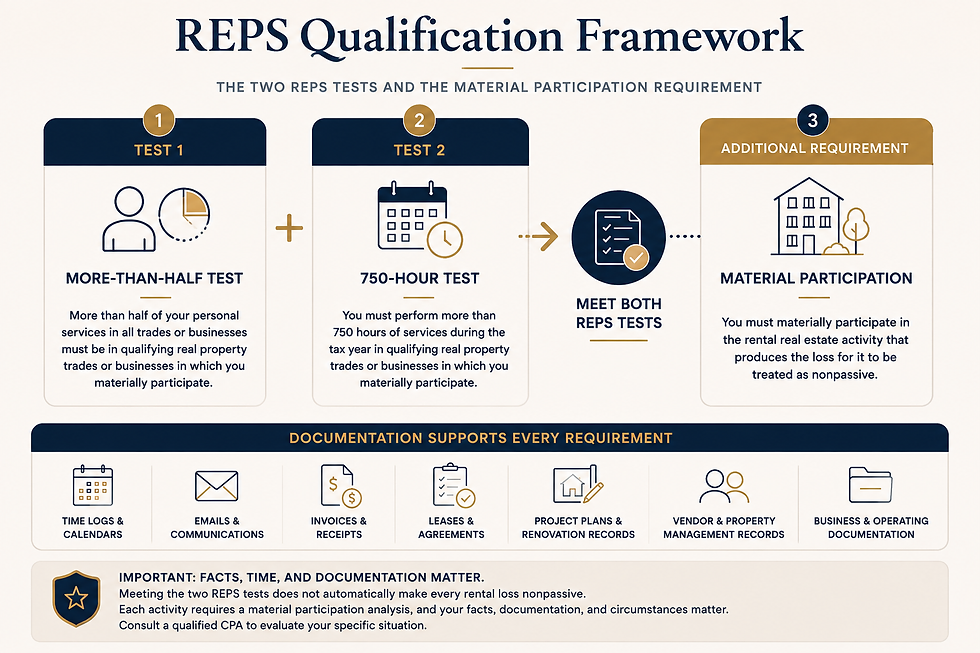
To qualify, you generally must meet both tests during the tax year.
This is where many high-income W-2 earners get tripped up.
If you work 2,000 hours per year as a physician, dentist, attorney, executive, or corporate employee, then doing 751 hours of real estate work may still not be enough. Why? Because more than half of your personal service time would still be in your W-2 job, not real estate.
That is why REPS is often more realistic in married households where one spouse is heavily involved in the real estate business while the other spouse continues earning W-2 income.
That was our situation as we were building our portfolio; Liz was the real estate professional. Tom had a W-2 job. The structure worked because Liz’s role in the business was real. She was not simply attached to the portfolio on paper.
That distinction matters.
Material Participation: The Part Many Investors Miss
REPS is not the end of the analysis, it is the first gate.
The next question is whether the taxpayer materially participates in the rental real estate activity.
The IRS lists several material participation tests, including participating for more than 500 hours, doing substantially all the work, participating more than 100 hours and at least as much as any other individual, and other tests based on prior-year participation or facts and circumstances.
For real estate investors, the practical point is this:
You can qualify as a real estate professional generally and still fail to materially participate in a specific rental activity.
That is a big deal.
For example, someone could be a full-time real estate agent and meet the 750-hour and more-than-half tests through brokerage work. But if they own a rental property that is fully managed by a third-party property manager and they barely touch it, they may not materially participate in that rental activity.

REPS does not magically turn every rental loss into a usable deduction. The rental activity still has to qualify as nonpassive based on material participation.
Why One Spouse May Qualify While the Other Keeps a
W-2
For married couples, REPS can be especially important.
The IRS says that if you file a joint return, you do not count your spouse’s personal services to determine whether you meet the REPS tests. However, your spouse’s participation can count when determining whether you materially participated in an activity.
This is nuanced, but important.
In a household where one spouse has a demanding W-2 job and the other spouse runs the real estate business, the real estate spouse may be able to qualify for REPS based on their own time and work.
This is why REPS often comes up for:
Physicians and dentists with a spouse managing rentals
Executives whose spouse runs the real estate business
Couples transitioning from small rentals into larger portfolios
Families where one spouse leaves or reduces W-2 work to operate the portfolio
Investors moving from passive ownership to active operations
The point is not to put a spouse’s name on the business and hope for the best. The point is to structure the business around what is actually happening.
If one spouse is truly sourcing deals, managing renovations, coordinating vendors, handling leasing, making operational decisions, overseeing bookkeeping, managing guest experience, and driving the portfolio forward, that may support the facts.
If they are not, then the structure should not pretend they are.
What Counts as Real Estate Work?
The IRS defines real property trades or businesses broadly. They can include: developing, redeveloping, constructing, reconstructing, acquiring, converting, renting, leasing, operating, managing, or brokering real property.
That gives investors a wide range of potential qualifying activities.
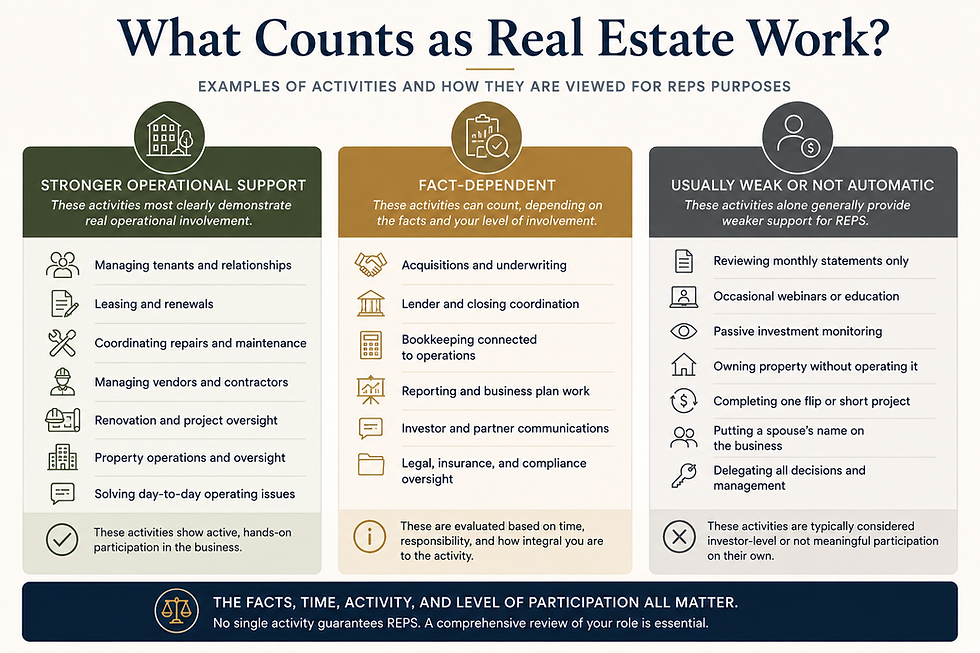
The theme is simple:
Real work counts better than real estate interest.
Understanding the Rules Is Only the First Step
Real Estate Professional Status depends on your individual circumstances, how your activities are documented, and how the tax rules apply to your situation. Building a strong foundation begins with understanding the framework before evaluating any investment strategy.
LTR vs. STR vs. Commercial Real Estate
One of the biggest misconceptions is that all real estate is treated the same, it is not.
The analysis can change depending on the property type, use, services provided, average customer stay, ownership structure, and who does the work.
Long-Term Rentals
Long-term rentals are the classic REPS conversation. A long-term rental is generally a rental activity. Rental activities are generally passive unless the taxpayer qualifies as a real estate professional and materially participates.
For long-term rental owners, the big issues are usually:
Do you qualify for REPS?
Do you materially participate?
Are properties treated separately or grouped through a proper election?
Are you using a third-party property manager?
Are your hours real and well documented?
Owning a few long-term rentals does not automatically qualify you. Approving a tenant, answering a few maintenance calls, and reviewing statements may not be enough.
Short-Term Rentals
Short-term rentals can be different because some activities may not be treated as rental activities under the passive activity rules if the average customer use is seven days or less, or if certain services are provided. IRS Publication 925 lists exceptions where an activity is not treated as a rental activity, including when the average customer use is seven days or less.
This is why people often talk about the “short-term rental loophole.”
But that phrase can be misleading.
Short-term rentals still require careful analysis. You still need to understand material participation. You still need good documentation. You still need to know whether the property is truly operating like a short-term rental business or more like a passive investment.
The fact that a property is listed on Airbnb or Vrbo does not automatically make the tax result work.
Commercial Real Estate
Commercial real estate can include office, retail, industrial, mixed-use, hospitality, flex space, or other income-producing property.
The REPS analysis often depends on whether the investor is actively involved in operations or is mostly a passive owner.
For example:
A passive limited partner in a commercial syndication generally should not assume they materially participate.
An operator managing leasing, capital projects, debt, vendors, tenants, reporting, and business plans has a very different fact pattern.
A boutique hotel or motel may involve operational business activity beyond simply collecting rent, depending on services and structure.
At BCG, this distinction matters because commercial real estate and hospitality are operational businesses. The numbers on a spreadsheet matter, but execution matters just as much.
A tax position should reflect the real operating role.
Common Misconceptions About REPS
Misconception 1:
“I own rentals, so I qualify.”
No. Ownership is not enough.
REPS is based on time, services, material participation, and the nature of the activities.
Misconception 2:
“I did one flip, so I qualify.”
Not automatically.
A flip may involve real estate work, but one project does not automatically satisfy the more-than-half test, the 750-hour test, or the relevant participation requirements.
Misconception 3:
“My CPA will just figure it out at tax time.”
This is risky.
Your CPA cannot create documentation after the fact that reflects work you did not actually do. Good tax planning starts before the year is over, not after you are trying to file.
Misconception 4:
“If one spouse qualifies, everything is solved.”
Not quite.
One spouse may qualify, and that can be powerful on a joint return, but the rental activities still need to be analyzed for material participation, grouping elections, documentation, and whether losses are otherwise limited.
Misconception 5:
“Short-term rentals always avoid the passive loss rules.”
No.
Short-term rentals can have different treatment, but they are not automatic. Average stay, services, material participation, and operating structure all matter.
Misconception 6:
“The tax benefit is the reason to buy the deal.”
This may be the most dangerous misconception.
Tax benefits can improve an already sound investment. They should not be used to justify a bad one.
Documentation: Where REPS Claims Often Succeed or Fail
Documentation matters.
The IRS says taxpayers can use any reasonable method to prove participation and do not necessarily need contemporaneous daily time reports if they can establish participation in another reasonable way, such as an appointment book, calendar, or narrative summary.
That said, from an operator standpoint, we would not treat documentation casually.
If your REPS position is important to your tax strategy, your records should be clear enough that someone else can understand:
What work was performed
Who performed it
When it happened
How long it took
Which property or business it related to
Why it was operational rather than merely investor-level review
A vague spreadsheet created months later is weaker than a consistent system built during the year.
A good REPS log should include:
Field | Example |
Date | March 14 |
Property/activity | 12-unit rental / renovation |
Task | Reviewed contractor bids and selected scope |
Time spent | 1.5 hours |
Category | Renovation management |
Supporting record | Email thread, invoice, calendar invite |
Documentation is not just about surviving an audit.
It also forces honesty.
If the log does not support the story, the story may be wrong.
Who Should Care About REPS?

REPS is most relevant for people who have both:
Meaningful real estate losses or deductions that may otherwise be passive
A real path to qualifying through actual work and material participation
The people who should pay attention include:
High-Income W-2 Earners
Especially those who are phased out of the $25,000 active participation allowance and are trying to understand why their rental losses are suspended.
Physicians and Dentists
Medical professionals often have high active income, limited time, and a strong interest in real estate. But that same demanding career can make it hard for the working spouse to meet the more-than-half test.
Married Couples Building a Portfolio
This is one of the most common planning situations. One spouse may keep the W-2 income while the other spouse takes on the real estate business in a serious, documented way.
Active Rental Owners
If you self-manage, renovate, lease, and operate your properties, REPS may be worth discussing with your CPA.
Investors Moving Into Commercial or Hospitality
As portfolios become more operational, the amount of real estate work can increase. Hospitality, boutique hotels, motels, and value-add commercial assets often require hands-on execution.
People Who Should Be Careful
REPS may not be realistic for investors who:
Work full-time outside real estate and have limited real estate hours
Own only passive syndication interests
Use full-service property management with little owner involvement
Have poor records
Are mainly interested in tax savings rather than buying strong assets
Want the benefits without changing how they actually operate
BCG Operator Take: REPS Is Powerful, But Not Casual
Here is our honest view.
REPS can be financially powerful.
We have used it in our own portfolio structure, with Liz as the real estate professional while Tom worked a W-2 job during the earlier stages of building the business. That was not a paper strategy. It reflected how the work was actually being done.
But REPS is not something investors should casually claim because they heard about it on a podcast.
The structure should follow the reality of the work.
The documentation should support the role.
The CPA should be involved early
The investment should make sense even without the tax benefit.
Real estate tax advantages are valuable, but they are not a substitute for buying right, managing debt carefully, controlling basis, executing the business plan, and protecting downside.
A bad deal with a tax benefit is still a bad deal.
A good deal with thoughtful tax planning can be even stronger.
REPS Qualification Checklist
Use this as a discussion guide with your CPA, not as tax advice.
Question | Yes/No |
Did one spouse or taxpayer spend more than 750 hours in qualifying real property trades or businesses this year? |
|
Did that same person spend more than half of their total working time in those real property trades or businesses? |
|
Were those activities ones in which the taxpayer materially participated? |
|
Did the taxpayer materially participate in the rental real estate activity producing the loss? |
|
Are the properties separate activities, or was a proper grouping election made? |
|
Is there a clean time log with dates, tasks, hours, and property/activity references? |
|
Do emails, calendars, invoices, leases, project records, or management records support the log? |
|
Was the taxpayer doing operational work rather than merely investor-level review? |
|
Has a qualified CPA reviewed the facts before filing? |
|
Would the investment still make sense without the tax benefit? |
|
If the answer to several of these is unclear, slow down.
Looking Beyond Tax Benefits?
Many investors explore Real Estate Professional Status as part of a broader strategy that includes professionally managed commercial real estate. Learn how private real estate investments are structured and what experienced sponsors consider when evaluating opportunities.
FAQ
What is Real Estate Professional Status?
Real Estate Professional Status is a tax classification under the passive activity loss rules. If a taxpayer qualifies and materially participates in rental real estate activities, certain rental real estate income or losses may be treated as nonpassive rather than passive.
Does owning rental property make me a real estate professional?
No. Ownership alone does not qualify you. You generally need to meet the more-than-half test, the 750-hour test, and the material participation requirements.
Can I qualify for REPS if I have a full-time W-2 job?
It can be difficult. If you work full-time outside real estate, you may struggle to show that more than half of your personal service time was spent in real property trades or businesses. This is why many households look at whether one spouse can genuinely qualify.
Can one spouse qualify for REPS while the other keeps working?
Potentially, yes. For joint returns, one spouse’s personal services are not counted to determine whether the other spouse meets the REPS tests, but spouse participation can count for material participation. This is a nuanced area that should be reviewed with a qualified CPA.
Do short-term rentals qualify for REPS?
Short-term rentals can have different treatment under the passive activity rules, especially when the average customer use is seven days or less, but they are not automatic. Material participation, services provided, average stay, and documentation still matter.
Is commercial real estate treated differently?
It depends on the structure and your role. Passive ownership of a commercial real estate investment is very different from actively operating, leasing, renovating, and managing commercial property.
Do passive investors in syndications qualify?
Usually, passive investors should be careful. Limited partners and passive investors often do not materially participate in the underlying activity. The specific facts and entity structure matter.
What kind of documentation should I keep?
Keep a detailed time log with dates, tasks, hours, activity or property, and supporting records. Calendars, emails, invoices, project notes, lease records, and management communication can help support the work performed.
Should I buy real estate just to qualify for REPS?
No. REPS should not be the only reason to buy real estate. Tax benefits can enhance a strong investment, but they cannot fix poor basis, bad debt, weak operations, or a flawed business plan.
Final Thoughts
Real Estate Professional Status can be one of the most valuable tax concepts for active real estate investors and certain high-income households.
But it is not casual and it is not automatic.
It is not something to reverse-engineer after the year is over.
The investors who should take REPS seriously are the ones building real operating businesses around real estate — managing assets, solving problems, making decisions, documenting their work, and involving qualified tax professionals early.
That is the lens we believe investors should use.
Not “How do I claim this?”
But:
“Does the way we actually operate support this?”
That question leads to better tax planning, better records, better structure, and usually better investing decisions.
If you are a high-income professional or married couple evaluating real estate as part of your long-term wealth strategy, start with the fundamentals: asset quality, debt, basis, operations, and downside protection.
Tax strategy matters, but it should support a strong investment thesis — not replace one.
At Bono Capital Group, we focus on practical real estate education and operator-led investing across commercial real estate, hospitality, boutique hotels/motels, and value-add assets.
To learn more about how we think about risk, execution, and long-term wealth building through real estate, connect with Bono Capital Group or explore our investor education resources.
Disclaimer
This article is for educational purposes only and should not be considered tax, legal, investment, or financial advice. Real Estate Professional Status is highly fact-specific, and the rules can vary based on your income, filing status, ownership structure, level of participation, documentation, and other limitations. Consult a qualified CPA, tax advisor, and attorney before making tax or investment decisions. Real estate investments involve risk, including potential loss of capital. Any tax benefits are subject to applicable law and are not guaranteed.


Comments