How to Read a Real Estate PPM Before You Invest

A practical guide for first-time passive investors and accredited investors reviewing real estate syndications.

A real estate Private Placement Memorandum, often called a PPM, can feel intimidating the first time you open one.
It may be 80, 100, or even 150 pages long. It may include legal language, risk factors, subscription documents, operating agreements, tax disclosures, fee schedules, investor questionnaires, and pages of fine print.
That is exactly why you need to read it carefully.
A PPM is not just a formality. It is one of the most important documents you will review before investing passively in a real estate syndication, private placement, or commercial real estate opportunity.
At Bono Capital Group, we believe investors should look beyond the projected returns and spend more time asking:
What assumptions are driving these numbers?
What happens if the plan takes longer?
What happens if interest rates, occupancy, renovation costs, insurance, taxes, or exit cap rates move against the deal?
How will the sponsor communicate if things do not go according to plan?
Because in real estate, the numbers in the deck are always projections. The PPM is where you start understanding the risks behind those projections.
A real estate Private Placement Memorandum (PPM) is an offering document that explains the terms, risks, fees, sponsor authority, investor rights, conflicts of interest, business plan, and subscription requirements of a private real estate investment. Before investing, review the PPM for the assumptions behind projected returns, downside risks, debt terms, fees, distribution waterfall, capital-call provisions, transfer restrictions, and what the sponsor can change without investor approval.
Table of Contents
What Is a PPM?
A Private Placement Memorandum is a legal disclosure document used in a private investment offering.

In real estate, a PPM is commonly used when a sponsor or general partner raises investor capital for a private deal, such as:
Multifamily acquisitions
Boutique hotels or motels
Commercial real estate
Hospitality assets
Value-add properties
Development or redevelopment projects
Real estate funds
Syndicated investment opportunities
The PPM usually explains the offering terms, risk factors, sponsor compensation, investor eligibility, use of proceeds, business plan, conflicts of interest, legal structure, tax considerations, and the documents investors must sign to participate.
Many real estate private offerings rely on exemptions from SEC registration, such as Regulation D. Offerings relying on Rule 506 of Regulation D are exempt from SEC registration when applicable requirements are satisfied. Issuers relying on Regulation D must generally file a Form D notice with the SEC within 15 days after the first sale.
That does not mean the investment is “approved” by the SEC. It also does not mean the deal is automatically good, bad, safe, or risky.
It means the investor has to do the work. The PPM is one of the first places to start.
Why a PPM Matters Before You Invest
A good PPM helps you understand the deal behind the deal, the pitch deck may show the upside, the webinar may explain the story, the sponsor may walk through the business plan.
But the PPM is where you typically find the legal terms, risk disclosures, fee language, investor rights, sponsor authority, and the details that may not fit neatly into a marketing presentation.
For a first-time passive investor, this is important because private real estate investments are not like buying a publicly traded stock.
You usually cannot sell your position whenever you want, you may have limited control.
Your capital may be tied up for years, distributions may pause, projected returns may change, the business plan may take longer than expected, a refinance or sale may not happen on the original timeline.
That is why we encourage investors to read the PPM with one main question in mind:
What am I actually agreeing to?
Not just what returns are being projected, not just what the best-case scenario looks like,
not just what the sponsor expects to happen.
What are you actually agreeing to if the plan changes?
The Wrong Way to Read a PPM
Many investors read a PPM backwards.
They start with the return projections. They look for the preferred return, IRR, equity multiple, cash-on-cash return, and hold period. Then they skim the rest.
That is understandable, especially when you are reviewing a deal for the first time.
Everyone wants to know what the investment may produce.
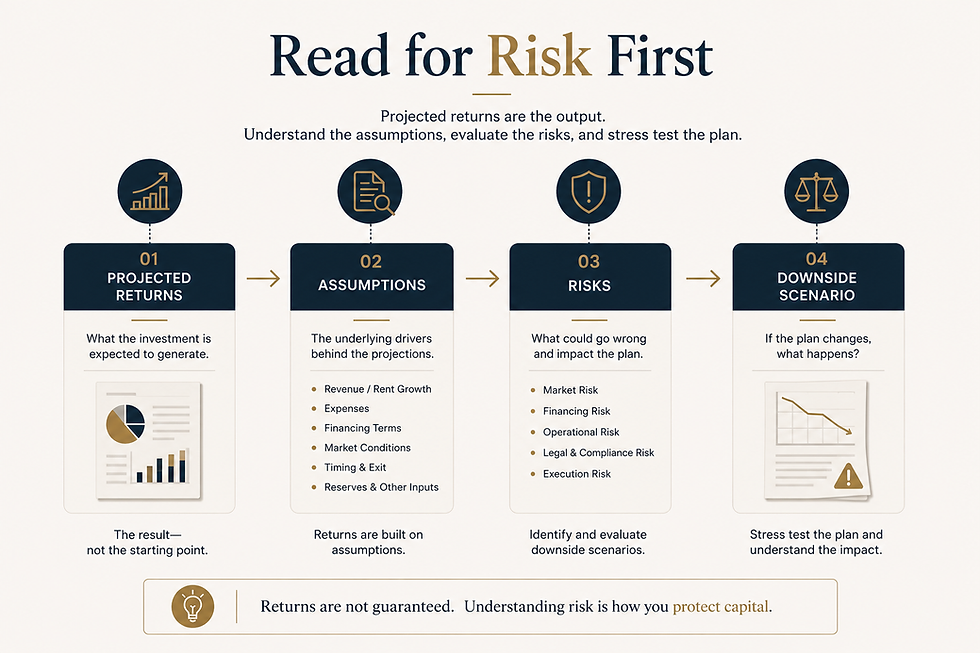
But projected returns are not the whole investment, they are the result of assumptions.
If the assumptions are too aggressive, the returns may look better than the risk profile really supports.
If the exit cap rate is too optimistic, the sale price may be overstated.
If renovation costs are too low, the budget may be tight.
If lease-up timing is too fast, cash flow may lag.
If interest rate assumptions are stale, debt service may be underestimated.
If operating expenses are too light, net operating income may be overstated.
The wrong way to read a PPM is to ask, “What return can I make?”
A better way is to ask:
What has to go right for these returns to happen?
And just as importantly:
What happens if those things do not go right?
The BCG Approach: Read for Risk First
At Bono Capital Group, we believe passive investors should read a PPM with a downside-first mindset.
That does not mean being negative, it means being realistic.
Every sponsor has a best intent when presenting a business plan. The goal is to execute the plan, follow the underwriting, communicate with investors, and deliver the projected outcome.
But markets change, debt markets change, insurance costs change, labor costs change. construction pricing changes, tourism patterns change, tenant demand changes, unexpected events happen.
COVID was a clear reminder that even well-underwritten real estate can be affected by events no one fully predicted.
So when we review a deal, we want to understand:
What does the base case assume?
What does the downside case look like?
What has to happen for the upside case?
How much room is there for mistakes?
How will the sponsor communicate if the plan changes?
What is the investor’s position if distributions pause?
What risks are being clearly acknowledged?
The best operators do not pretend risk does not exist.
They explain it.
They plan for it.
They communicate through it.
That is the standard investors should look for when reading a PPM.
Key Sections Every Investor Should Review
Every PPM is different, but most include several sections that deserve close attention.
Here is a practical way to review them.
PPM Section | What It Usually Covers | What Investors Should Ask |
Offering Summary | Basic deal terms, target raise, minimum investment, entity structure | What exactly am I buying? |
Risk Factors | Legal, market, operational, financing, tax, and execution risks | What could go wrong? |
Use of Proceeds | How investor capital will be used | How much goes to the asset vs. fees, reserves, and closing costs? |
Business Plan | Acquisition, renovation, operations, refinance, sale, or hold strategy | Is the plan realistic? |
Underwriting Assumptions | Rent growth, expenses, occupancy, cap rates, debt, exit value | What assumptions drive the returns? |
Fees and Compensation | Acquisition fees, asset management fees, disposition fees, refinance fees, promotes | How is the sponsor paid? |
Distributions | Preferred return, cash flow splits, waterfall, timing | When do investors get paid, and what must happen first? |
Sponsor Authority | What the GP can decide without investor approval | How much control do passive investors have? |
Conflicts of Interest | Related-party transactions, affiliated vendors, sponsor discretion | Where could incentives conflict? |
Transfer Restrictions | Whether investors can sell or transfer interests | How liquid or illiquid is this investment? |
Tax Matters | K-1s, depreciation, taxable income, unrelated business taxable income, state filings | What should I ask my CPA? |
Subscription Agreement | Investor representations and legal commitments | What am I certifying when I sign? |
Communication Terms | Reporting cadence, notices, investor updates | How will I know what is happening? |
This table should not replace legal review, but it gives investors a practical starting point.
The point is not to memorize every clause, the point is to slow down before wiring funds.
For investors learning how to read a real estate PPM, the most important sections are usually the offering terms, risk factors, underwriting assumptions, fees, distribution structure, and investor rights.
How to Read a Real Estate PPM: Review the Underwriting Assumptions
The underwriting assumptions are one of the most important parts of the investment, this is where the projected returns are built.
A sponsor may show a targeted IRR, equity multiple, preferred return, or cash-on-cash return, but those outputs only matter if the inputs are reasonable.
When reviewing the PPM and supporting materials, look closely at these assumptions.
1. Purchase Price and Basis
Basis matters. If the sponsor is buying the asset at an attractive basis, there may be more room to handle market changes.
If the deal requires everything to go right just to justify the purchase price, there may be less margin for error.
Ask:
Is the purchase price supported by current income?
Is the sponsor relying heavily on future rent growth or future revenue growth?
How does the basis compare to replacement cost or comparable sales?
Is the asset being bought below, at, or above market value?
In real estate, you do not control the market.
But you can control what you pay.
2. Revenue Growth
Revenue assumptions can make or break a deal.
For apartments, this may mean rent growth and occupancy. For hospitality, this may mean average daily rate, occupancy, RevPAR, seasonality, and local demand.
For commercial property, this may mean lease-up timing, tenant retention, renewal spreads, and market rents.
Ask:
How fast does revenue need to grow?
Is growth supported by current market data?
What happens if revenue grows slower?
Is the business plan dependent on aggressive increases?
A deal should not need perfect conditions to survive.
3. Expense Assumptions
Expenses are often where investors miss risk.
Insurance may rise, property taxes may reassess, payroll may increase. utilities may move. repairs may cost more than expected, third-party management may underperform.
Ask:
Are expense assumptions based on actual trailing numbers or projections?
Has the sponsor accounted for tax reassessment?
Are insurance quotes current?
Are reserves adequate?
What expenses are most likely to surprise the deal?
One of our practical rules: do not only look at revenue upside. Study expense pressure.
4. Debt Terms
Debt can help returns, but it can also increase risk. Investors should understand whether the debt is fixed or floating, when it matures, whether there are extension options, what covenants exist, and whether the deal depends on a refinance.
Ask:
Is the loan fixed-rate or floating-rate?
Is there an interest rate cap?
When does the loan mature?
What happens if the refinance market is not attractive?
Are there cash management triggers or covenants?
Does the business plan depend on selling or refinancing by a certain date?
The capital stack matters as much as the asset.
5. Exit Assumptions
A lot of projected return comes from the exit. If the sponsor assumes the property can be sold at a favorable cap rate, investors need to understand whether that assumption is conservative, realistic, or aggressive.
Ask:
What exit cap rate is being used?
Is it higher or lower than the going-in cap rate?
What happens if the exit cap rate expands?
What sale price is needed to hit the projected returns?
Is the exit timeline flexible?
The exit is not fully within the sponsor’s control. That is why investors should ask for a
range of outcomes, not just one return projection.
When reviewing projected returns, test:
Purchase price and basis
Revenue growth
Operating expenses
Debt terms
Exit assumptions
The projected returns are outputs. The assumptions are the inputs.

Going beyond the PPM?
Learn how passive real estate investments are structured, how investors may receive returns, and what to evaluate before committing capital.
How to Think About Projected Returns
Projected returns are not promises, they are estimates based on assumptions.
This is one of the most important points for passive investors to understand.
A sponsor’s goal is usually to follow the business plan and pursue the stated targets. But the final result can change because market conditions, capital markets, operating performance, costs, timing, and unexpected events can all change.
Here is how to think about the most common return metrics.
Metric | What It Means | How Investors Should Read It |
IRR | Annualized return calculation that accounts for timing of cash flows | Useful, but sensitive to timing, refinance events, and early exits |
Equity Multiple | Total cash returned divided by total equity invested | Helpful for understanding total return over the life of the deal |
Cash-on-Cash Return | Annual cash flow compared to invested equity | Important for income expectations, but distributions may vary or pause |
Preferred Return | A return threshold investors may receive before sponsor promote, depending on the waterfall | Not always guaranteed; read the exact waterfall language |
Hold Period | Expected time the investment will be held | A projection, not a certainty |
Distribution Schedule | Expected timing of investor payments | Subject to property performance, reserves, lender requirements, and sponsor discretion |
The mistake is treating projected returns as fixed.
A better approach is to ask for multiple cases:
Base case
Conservative case
Downside case
Break-even case
Worst-case scenario
At BCG, we believe a thoughtful sponsor should be able to explain the range.
Not every deal needs to show massive upside, but every deal should be able to explain the downside.
Questions to Ask About the Worst-Case Scenario
One of the best questions an investor can ask is:
What does the downside case look like?
Not in theory, in numbers.
Ask the sponsor:
What happens if revenue is 10% lower than projected?
What happens if expenses are 10% higher than projected?
What happens if the exit cap rate is higher than projected?
What happens if the refinance does not happen?
What happens if the hold period extends by two years?
What happens if distributions pause?
What happens if renovations cost more or take longer?
What happens if occupancy drops?
What happens if interest rates move against the deal?
What is the approximate break-even occupancy or revenue level?
These questions do not mean you are trying to talk yourself out of investing.
They mean you are trying to understand the investment like an owner. That is the mindset passive investors should develop.
Communication, Reporting, and Transparency
Communication is often overlooked when investors read a PPM.
When a deal is going well, communication is easy.
When a deal is behind plan, communication matters even more.
Before investing, review what the PPM or investor materials say about:
Reporting frequency
Investor updates
Financial reporting
K-1 timing
Capital calls
Major decisions
Distribution notices
Business plan changes
Sale or refinance updates
Then ask the sponsor directly:
How often do you communicate with investors?
What do your updates include?
Do you report only good news, or do you discuss challenges too?
What happens if the deal is off track?
Who answers investor questions?
How quickly do you typically respond?
Can I see a sample investor update?
At BCG, we believe investors deserve clear, consistent communication, that does not mean every update will be exciting. Sometimes the best update is a plain-English explanation of what changed, what the team is doing about it, and what investors should expect next.
Transparency builds trust, silence destroys it.
What the Fine Print Can Tell You
The fine print is where many important details live.
Investors should pay attention to language around:
Sponsor Discretion
The PPM may give the sponsor broad authority to make decisions without investor approval.
That may be normal for a passive investment, but you should understand it.
Ask:
What decisions can the GP make alone?
What decisions require investor consent?
Can the business plan change?
Can the hold period extend?
Can the sponsor refinance or sell without approval?
Fees
Sponsor fees are not automatically bad.
Sponsors need to operate the deal, manage the asset, oversee reporting, execute the business plan, and be compensated for their work.
But investors should understand the fee structure.
Look for:
Acquisition fees
Asset management fees
Construction management fees
Property management fees
Disposition fees
Refinance fees
Loan guaranty fees
Organization and offering expenses
Affiliate fees
Ask whether fees are aligned with performance or paid regardless of outcome.
Conflicts of Interest
Conflicts are common in private real estate.
The issue is not whether conflicts exist, the issue is whether they are disclosed and managed.
Examples may include:
Sponsor affiliates providing services
Related-party property management
Sponsor investing in multiple deals at once
Allocation of opportunities among funds or entities
Fees paid to sponsor-controlled companies
Read this section carefully.
Then ask the sponsor to explain it in plain English.
Capital Calls
Some deals allow the sponsor to request additional capital from investors.
You need to know:
Are capital calls allowed?
Are they mandatory or optional?
What happens if an investor does not participate?
Can your ownership be diluted?
Could there be penalties?
Even if the sponsor does not expect a capital call, investors should understand what the documents allow.
Transfer Restrictions
Private real estate investments are usually illiquid.
You may not be able to sell your interest easily.
You may need sponsor approval to transfer your ownership.
There may be no secondary market.
Investors should understand this before investing.
Private placement securities often have resale restrictions, which is another reason the SEC encourages investors to understand the terms and risks before participating. (Investor.gov)
The Subscription Agreement Matters Too
Many investors focus on the PPM and rush through the subscription agreement.
That is a mistake.
The subscription agreement is where you formally agree to invest.
It may include representations about your financial status, investor eligibility, investment experience, understanding of risk, source of funds, and acknowledgement that the investment is illiquid and speculative.
In many Regulation D offerings, investor eligibility may depend on accredited investor status. The SEC explains that the accredited investor definition is used by companies to determine who may be eligible to participate in many private market offerings. (SEC)
Investors should not treat these documents as “click to agree” paperwork.
You are making legal representations, read them, ask questions, speak with your attorney, CPA, or financial advisor when needed.
Common Mistakes Investors Make When Reading a PPM
Mistake 1: Reading Only the Return Page
The returns are the output.
The assumptions are the engine.
Spend more time on the assumptions than the headline projections.
Mistake 2: Ignoring the Risk Factors
Risk factors may feel repetitive or overly legal.
Read them anyway. They show you what the sponsor and counsel believe could materially affect the investment.
Mistake 3: Not Asking About the Downside Case
A base case is not enough. Ask what happens if the market, debt, expenses, timing, or exit assumptions move against the deal.
Mistake 4: Assuming the Preferred Return Is Guaranteed
A preferred return is not the same thing as guaranteed income. The exact meaning depends on the waterfall and available cash flow.
Read the distribution section carefully.
Mistake 5: Not Understanding Fees
Fees affect investor economics.
You do not need to reject a deal because it has fees, but you should understand who gets paid, when, how much, and whether incentives are aligned.
Mistake 6: Overlooking Communication Standards
If communication is vague before you invest, it may not improve after you invest.
Ask how reporting works before wiring funds.
Mistake 7: Treating Legal Documents as a Formality
The PPM, operating agreement, and subscription agreement are the deal documents.
The marketing deck is not enough.
Practical PPM Review Checklist
Use this checklist before investing in a real estate private placement.
Deal Basics
Do I understand the asset type?
Do I understand the market?
Do I understand the business plan?
Do I understand the legal structure?
Do I know whether I am investing in a single asset, portfolio, or fund?
Sponsor and Operator
Who is the sponsor?
Who is the operator?
What is their experience with this asset type?
Have they executed a similar strategy before?
How much sponsor capital is invested?
Who manages day-to-day execution?
Underwriting
What rent, revenue, or occupancy growth is assumed?
What expense growth is assumed?
What debt terms are assumed?
What exit cap rate is assumed?
What reserves are included?
What happens if the plan takes longer?
What happens if the exit market is weaker?
Risk
What are the top risks?
Which risks could permanently impair capital?
Could distributions pause?
Could additional capital be required?
What happens if the refinance or sale does not happen as planned?
Fees and Alignment
What fees does the sponsor earn upfront?
What fees are ongoing?
What fees are paid at sale or refinance?
How does the promote work?
Does the sponsor benefit before investors receive projected returns?
Are there related-party fees?
Investor Rights
What voting rights do investors have?
What decisions can the GP make without approval?
Can the hold period be extended?
Can the investment strategy change?
Can investors transfer their interests?
Communication
How often will updates be sent?
What metrics will be reported?
Will financials be shared?
Who answers investor questions?
What happens when the deal is off plan?
Are sample updates available?
Tax
When are K-1s expected?
Are there state tax filing considerations?
Is depreciation expected?
Could there be taxable income without cash distributions?
Should my CPA review the structure?
A Simple Framework: Read the PPM in Four Passes
A PPM can be dense, so do not try to absorb everything in one pass.
Use this four-pass method.
Pass 1: Understand the Deal
Read the offering summary, business plan, use of proceeds, and projected terms.
Goal: understand what the investment is.
Pass 2: Understand the Risks
Read the risk factors, debt language, conflicts, capital call provisions, and transfer restrictions.
Goal: understand what could go wrong.
Pass 3: Understand the Economics
Read the fees, waterfall, preferred return, distribution policy, promote, and sponsor compensation.
Goal: understand how money flows.
Pass 4: Understand Your Rights and Responsibilities
Read the operating agreement, subscription agreement, investor representations, voting rights, and communication provisions.
Goal: understand what you are agreeing to.
This approach helps investors move from “Does this look interesting?” to “Do I understand the investment well enough to make a decision?”
FAQ
What does PPM stand for in real estate?
PPM stands for Private Placement Memorandum. In real estate, it is an offering document used in private investment opportunities to explain the deal terms, risks, legal structure, fees, investor rights, and subscription process.
Is a PPM the same as a pitch deck?
No. A pitch deck is usually a marketing or summary document. A PPM is a legal disclosure document. Investors should review both, but the PPM usually contains more detailed risk, fee, legal, and investor-rights language.
Does a PPM guarantee returns?
No. A PPM does not guarantee returns. Projected IRR, equity multiple, cash-on-cash return, preferred return, and hold period assumptions are projections. Actual results can change based on market conditions, execution, debt, expenses, timing, and unexpected events.
Should I have an attorney review a PPM?
Many investors choose to have an attorney review the PPM, operating agreement, and subscription agreement, especially if they are new to private placements. Investors should also consider involving a CPA or financial advisor when tax or portfolio-allocation questions are involved.
What is the most important part of a PPM?
There is no single section that tells the whole story. However, investors should pay close attention to the risk factors, underwriting assumptions, fees, sponsor authority, distribution waterfall, conflicts of interest, capital call provisions, and communication terms.
What should I ask the sponsor before investing?
Ask the sponsor to explain the downside case, key assumptions, debt risks, exit assumptions, fees, investor reporting process, and what happens if the business plan does not go according to schedule.
Are private placements reviewed by the SEC?
Private placements are generally not registered public offerings. The SEC notes that private placement memoranda and other offering documents are typically not reviewed by regulators, which makes investor diligence especially important. (Investor.gov)
What is an accredited investor?
An accredited investor is a person or entity that meets certain financial, professional, or institutional criteria under SEC rules. Accredited investor status is often used to determine eligibility for private market offerings. (SEC)
What is the difference between a preferred return and a guaranteed return?
A preferred return is a distribution priority described in the deal documents. It is not automatically guaranteed. Whether investors receive it depends on the waterfall language and the investment’s actual performance.
What is the biggest red flag in a PPM?
One major red flag is when the projected returns depend on aggressive assumptions, but the sponsor cannot clearly explain the downside case. Another is vague communication standards, especially if the sponsor cannot explain how investors will be updated when the deal is behind plan.
What should I look for in a real estate PPM?
Review the risk factors, underwriting assumptions, debt terms, fees, distribution waterfall, sponsor authority, conflicts of interest, capital-call provisions, transfer restrictions, investor rights, and subscription agreement. Pay particular attention to the assumptions driving projected returns and what happens if those assumptions are not met.
What are potential red flags when reviewing a real estate PPM?
Potential concerns include aggressive underwriting assumptions, unclear fees, broad sponsor discretion you do not understand, material conflicts of interest, weak downside analysis, or vague investor communication standards. A concern does not automatically make an investment unsuitable, but it should lead to additional diligence and questions.
The BCG Four-Pass PPM Review
Pass 1 — Deal: What am I investing in?
Pass 2 — Risk: What could go wrong?
Pass 3 — Economics: How does money flow?
Pass 4 — Rights: What am I agreeing to?
Have a deal you're evaluating?
Understanding the PPM is only one part of the diligence process. Learn more about how Bono Capital Group approaches underwriting, risk, and investor alignment.
Final Thoughts
A PPM is not always easy to read, but it is worth the time.
For passive investors, the goal is not to become a securities attorney. The goal is to understand the investment well enough to ask better questions before committing capital.
Do not stop at the return projections. Read the fine print. Study the assumptions. Ask about the worst-case scenario. Understand the fees. Understand your rights. Understand how communication will work.
Most importantly, remember that every number in a real estate private placement is a projection.
The sponsor may have every intention of executing the plan exactly as presented, but real estate does not happen in a vacuum. Markets change. Costs change. Debt changes. Timelines change. Unexpected events happen.
A thoughtful investor does not need certainty.
A thoughtful investor needs clarity.
That is what a good PPM review should help create.
Before you invest passively in commercial real estate, make sure you know what to look for.
Download our Passive Investor’s Guide to Commercial Real Estate to better understand deal structures, risk factors, return projections, and the questions to ask before investing.
If you are reviewing a real estate investment opportunity and want to learn more about BCG’s approach, schedule a call with Bono Capital Group.
Disclaimer
This article is for educational purposes only and does not constitute investment, legal, tax, accounting, or financial advice. Private real estate investments involve risk, including possible loss of capital, illiquidity, changes in market conditions, financing risk, operational risk, and tax consequences. Projected returns are not guaranteed, and actual results may differ materially from expectations. Investors should review all offering documents carefully and consult their own attorney, CPA, financial advisor, or other qualified professionals before making an investment decision.


Comments